MSP Profitability

Home  MSP Profitability

Dijital Team

The Ultimate Guide to MSP Profitability.


MSP profitability is not just about cutting costs. It is about building a service business that can grow without crushing your margins, overwhelming your team, or reducing client experience. For most Managed Service Providers (MSPs) and IT service businesses, the real question is not How do we get more revenue? It is How do we turn revenue into healthy gross margin, reliable EBITDA, stronger cash flow, and a more valuable business?

This guide is built for MSP and IT Service Provider owners who want to improve financial performance without losing momentum. If you are hiring slowly, carrying too much ticket noise, struggling to price confidently, or wondering why growth still feels hard, you are in the right place.

Sri Lankan offshore team
Compound Improvement = Sustainable Profitability
Higher Margins • Stronger Cash Flow • Happier Teams • More Value • Faster Growth

The five operating levers that compound MSP profitability over time. 

Executive Summary


The most profitable MSPs do not rely on a single silver bullet. They improve profitability by compounding small advantages across pricing, service design, ticket efficiency, automation, skill mix, and leadership discipline. They are intentional about the clients they serve, the work they standardise, the tasks they automate, and the roles they build.

In practical terms, that means five things. First, they package and price for outcomes instead of undercharging for complexity. Second, they improve service desk efficiency so technicians spend more time resolving and less time chasing, updating, and reworking tickets. Third, they build the right team structure, often using a mix of onshore leadership and scalable delivery capacity. Fourth, they automate repetitive work so headcount does not have to rise at the same speed as ticket volume. Fifth, they run the business by benchmarks, not by feeling.

Sri Lankan offshore team

If your goal is to improve MSP profitability, start with visibility. Know your service gross margin, EBITDA, tickets per technician, first-touch resolution trends, client profitability, and how much work is still manual. Then prioritise the bottleneck that has the biggest impact on cost-to-serve. In many MSPs, that is the service desk. In others, it is poor pricing discipline, weak packaging, or an overreliance on expensive local hiring for work that could be delivered through a more scalable model.

The rest of this guide shows you how to diagnose those issues, improve them, and turn profitability into something more durable than a short-term margin bump. Done well, profitability becomes leverage. And leverage is what gives an MSP room to grow, room to innovate, and room to build enterprise value.

What MSP Profitability Actually Means


MSP profitability is often misunderstood because many owners look only at top-line revenue. Revenue matters, but it can hide operational problems. You can grow monthly recurring revenue and still create a worse business if every new client adds messy work, unpriced complexity, or hiring pressure that eats away at margin. That is why profitable MSPs focus on both growth and the quality of the engine underneath it.

At a minimum, every MSP owner should understand four financial lenses. The first is service gross margin, which tells you how much revenue remains after direct delivery costs. The second is EBITDA, which shows how effectively the business converts revenue into operating profit. The third is labor leverage, which answers whether each technician, coordinator, or engineer is producing enough value relative to cost. The fourth is client profitability, because not every client contributes equally to your margins.

Sri Lankan offshore team

The Core Metrics Every Owner Should Track


If you want a simple dashboard, start here: service gross margin, EBITDA margin, tickets per technician, first-touch or first-contact resolution trend, average handle time, reopened tickets, utilisation for project and higher-tier engineers, client churn, average revenue per client, and expansion revenue from security, cloud, backup, and advisory work. You do not need a perfect finance pack on day one, but you do need enough visibility to identify which part of the model is leaking value.

High-performing owners also keep a close eye on mix. Are you building too much of your business around low-value reactive support? Are project engineers spending too much time inside escalations? Are premium people doing work that could be standardised or delegated? Are clients buying outcomes, or are you still selling labor and hoping the numbers work themselves out later?

When owners start measuring the business this way, profitability stops being a vague aspiration and becomes a series of specific operational decisions. That is the point where improvement becomes possible.

Sri Lankan offshore team

Why MSP Margins Get Squeezed


MSP margins rarely collapse because of one dramatic event. More often, they erode quietly. A few underpriced agreements, too many reactive tickets, a stack of tools that do not talk to each other, great senior engineers stuck in repetitive support work, slow hiring, weak sales handovers and too much variation between clients. None of those issues seem fatal by themselves, but together they create operational drag that turns growth into stress rather than profit.

Smaller Deals, Bigger Expectations

The current MSP market is still full of demand, but it is becoming more selective. Initial deal sizes are under pressure, customers expect faster outcomes, and many providers are trying to add AI, security, compliance, and advisory language without fully changing their delivery model. That creates a gap between what the customer hears in the sales process and what the operations team can profitably deliver.

This is why packaging matters. If your agreements are too broad, too bespoke, or too slow to evolve, you end up absorbing complexity for free. Owners often think they have a staffing issue when they really have a service design issue. Fix the design, and the staffing equation usually improves.


The Talent and Skills Constraint

Talent remains one of the biggest profitability constraints for MSPs. Skills shortages slow hiring, local salary pressure increases delivery cost, and waiting too long to build capacity usually forces owners into reactive recruitment decisions. That is expensive. It also pushes higher-value people into lower-value work because there is nobody else available to absorb the flow.

A more profitable model usually has better role clarity. L1, L2, L3, project, automation, admin, and service delivery responsibilities are separated intentionally. The best owners do not ask, “Can this person do it?” They ask, “Is this the right-cost role to do it well at scale?”

Tool Sprawl, Ticket Noise, and Operational Drag

Many MSPs are held back by ticket communication overhead, internal handoff friction, and too much repetitive work. A technician requests missing information. The customer replies later. Someone re-reads the thread. The ticket gets escalated through Teams, email, or side-channel chat. Status updates are written manually. Meanwhile, the client wonders what is happening. This is not just slow. It is expensive.

Every unnecessary minute attached to a ticket compounds. Multiply that across hundreds or thousands of tickets per month and you get real margin erosion. That is why service desk efficiency is one of the fastest profitability levers available to an MSP owner.


The Five Levers That Improve MSP Profitability


Package and Price for Outcomes

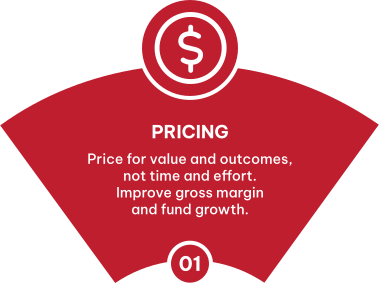
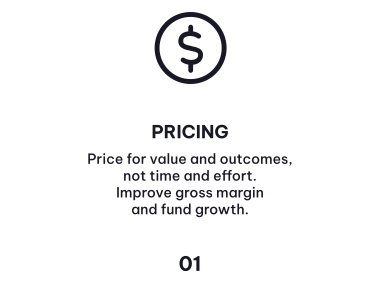
The first lever is pricing discipline. Profitable MSPs do not rely on hope-based pricing. They understand what their service commitments cost to deliver, they review legacy agreements regularly, and they make intentional decisions about what is included, what is standardised, and what falls outside scope.

If your best technical people are constantly pulled into custom requests that are not covered properly, your margin will suffer no matter how good your marketing is. Start by reviewing your agreements for hidden complexity. Then clarify inclusions, exclusions, response expectations, client dependencies, and premium services. Security, advisory, automation, and higher-complexity work should not disappear into the base agreement.

Owners often delay pricing changes because they fear churn. But underpricing is not neutral. It forces operational shortcuts, delays investment, and creates team stress. If you want healthy retention, first make the service economically sustainable.

The MSP Packaging and Pricing Challenge


Improve Service Desk Efficiency

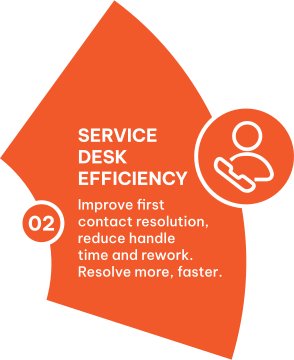
The second lever is service desk efficiency. This is usually where profitability becomes visible fastest, because service desks handle the highest volume and the most repetition. If your communication flow is messy, your ticket triage is poor, or your escalations lack structure, your technicians spend too much time on non-resolution work.

Start by mapping the ticket lifecycle. Where are tickets waiting? Where is information missing? Where do updates get written manually? Where do escalations happen outside the PSA? Where do customers follow up because the process is unclear? Each of those friction points has a labor cost.

Then focus on measurable improvements: better intake, more consistent categorisation, intelligent acknowledgment, standardised updates, tighter escalation paths, and better knowledge capture. The goal is not purely to close tickets faster. It is to reduce wasted effort and improve throughput without lowering quality.

A useful operations question is this: how much of your service desk work still depends on highly paid humans writing the same explanations over and over again? Every time you reduce administrative or communication overhead, you release capacity back into the system.

How to Improve Service Desk Communication Efficiency

Automate Repetitive Work

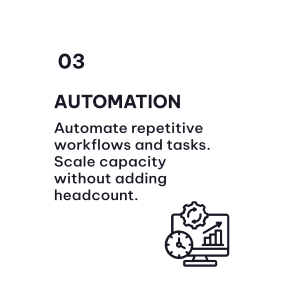
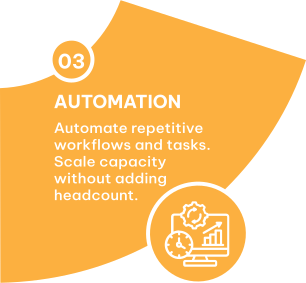
The fourth lever is automation. Automation is not valuable because it sounds modern. It is valuable because it reduces the amount of expensive human time spent on repeatable tasks. In a profitable MSP, automation protects margin by handling standardisation at scale: routing, enrichment, updates, scripting, data movement, reporting, issue prevention, and operational handoffs.

A simple way to think about it is this: if you can remove low-value repetition from the day, your team has more time for resolution, project delivery, proactive work, and customer conversations that actually create value. That improves labor leverage without asking people to work harder.

The best automation strategy is not “automate everything.” It is “automate the things that happen often, create avoidable cost, and are governed by repeatable rules”. That usually starts in the service desk, but it should also extend to internal admin, procurement, sales support, reporting, and platform operations.

Automation also changes the economics of hiring. Once repetitive tasks are removed, you can be more deliberate about where senior talent is used, what work gets standardised, and what capacity gaps really need a human solution.

Accelerating Internal Automation for Internal Efficiency


Build the Right Capacity Mix

The third lever is capacity design. Many MSPs try to solve profitability with more effort from the existing team. That works for a short period, then breaks. A more sustainable approach is to redesign the delivery model so the right work is being done by the right-cost role with the right level of skill.

In practice, that often means moving away from a model where local senior people absorb everything. It means building stronger L2 capability, separating project work from reactive support where possible, and creating room for specialists in automation, M365, security, data, or operations support. It can also mean using offshore capacity intentionally to improve leverage rather than just reduce salary cost.

The important distinction is this: good capacity design improves both margin and resilience. It gives the business more throughput, more flexibility, and better access to scarce skill sets. It also reduces owner dependence on heroic individuals, which is good for delivery today and business value tomorrow.

If your hiring model is still entirely reactive, this is one of the biggest opportunities on the table.

How MSPs Can Build the Right Capacity

Lead with Benchmarks and Accountability

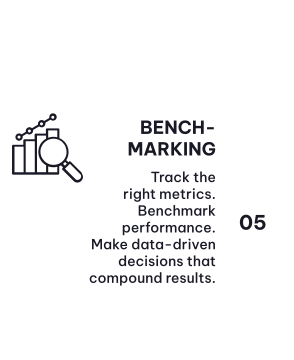
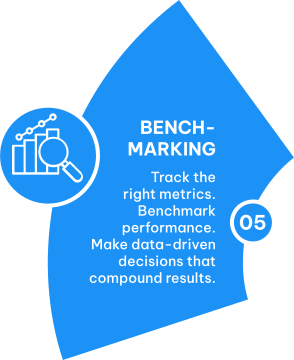
The fifth lever is leadership discipline. Many MSP owners know, at a gut level, that profitability needs work. Fewer can say exactly where profit is being lost this month, which client segments are underperforming, or which operating metrics are moving in the wrong direction. That is where benchmarks matter.

Your benchmark system does not need to be complex. It does need to be consistent. Review margin by service line, trend ticket volume and reopened work, track client profitability, watch project utilisation, measure sales efficiency, and compare labor growth to revenue growth. If labor costs rise faster than revenue while service quality stays flat, the model is not scaling.

Benchmarking also gives leadership a better language for decision-making. Instead of arguing from anecdotes, you can ask sharper questions. Which agreements have the worst effective margin? Which technicians are overloaded with low-value work? Which customers generate the most noise? Which automations will save the most technician time? Which roles should be built next?

The goal is not to create dashboards for their own sake. It is to create accountability that leads to better operational choices. The MSPs that improve profitability fastest are rarely guessing. They are measuring, prioritising, and acting with discipline.

The MSP Benchmarks That Really Matter


A Practical Ninety-Day Profitability Plan


In the first thirty days, focus on visibility and triage. Pull the baseline metrics. Identify the noisiest clients, the underpriced agreements, the most manual ticket stages, and the roles carrying the wrong work. Do not try to fix everything at once.

In days thirty to sixty, prioritise the highest-return bottleneck. That might be the service desk, pricing review, role redesign, or automation backlog. Pick one major lever and two supporting actions. For example: improve intake, standardise updates, and move lower-complexity repetitive work away from expensive senior roles.

In days sixty to ninety, turn the improvements into operating rhythm. Build the benchmark scorecard, review it weekly, document the wins, and identify the next layer of leverage. This is also the right time to assess whether a more scalable staffing model, including offshore support, would improve capacity, speed, and margin.

Sri Lankan offshore team

Frequently Asked Questions About MSP Profitability


Next Steps

If you want to improve MSP profitability, start by diagnosing where margin is leaking today. Then decide whether the best next move is pricing, efficiency, automation, benchmarks, or capacity design. If the challenge is delivery leverage, explore our MSP offshore team model, review the roles we build, or speak with us about the Better Business Pathway.

Profitability is not luck. It is design. The more intentional your operating model becomes, the more valuable your business can become.