- Local hire|100
- Sri Lanka|25
Lower comparative costs
Lower employment and operating costs can enable businesses to reinvest in growth, technology, training, leadership and customer experience.
Build More Capability. Improve Margins. Create a Better IT Business.
*An initial planning assumption. Savings vary by position, experience level and onshore comparison.
Dijital Team’s information-security practices are certified to ISO 27001 and supported through documented technical, physical and organisational controls.


The future of successful MSPs is not about replacing local teams. It is about creating the right blend of local and offshore capability.
And when it comes to building dedicated offshore teams for MSPs and IT service providers, we believe there is no better place in the world than Sri Lanka.
For many Managed Service Providers (MSPs), Technology Service Providers (TSPs), System Integrators, and software companies, growth is no longer constrained by demand. It is constrained by access to contemporary skills.
The challenge is finding skilled professionals, at the right cost, who can deliver exceptional outcomes while maintaining profitability.
This is why more MSPs and IT Service Providers are looking offshore.
The problem is that not all offshore destinations are created equal.
While countries such as India and the Philippines have dominated the outsourcing conversation for years, a growing number of ambitious IT businesses are discovering that Sri Lanka provides something different: highly skilled technology professionals, exceptional English communication, strong cultural alignment, impressive retention and access to modern technical capabilities.
For businesses looking to build dedicated offshore teams rather than simply outsource tasks, Sri Lanka has become one of the best-kept secrets in the global technology industry.
Lower employment and operating costs can enable businesses to reinvest in growth, technology, training, leadership and customer experience.
The strongest Sri Lankan professionals do not simply complete assigned tasks. They participate in conversations, suggest improvements and contribute to business outcomes.
Access experienced professionals across IT support, cloud, cybersecurity, automation, software development, data, finance, administration and customer service.
Sri Lanka has emerged as the most compelling destinations for businesses looking to build high-performing offshore teams.
The country combines a growing technology and professional-services sector with strong business communication, internationally recognised qualifications, competitive employment costs and a culture that values relationships, education and professional development.
For Managed Service Providers, IT Service Providers, Software Development and System Integrators, Sri Lanka provides access to experienced IT professionals who can become embedded members of your team rather than anonymous outsourced resources.
Dijital Team designs and builds dedicated offshore teams in Sri Lanka based on the exact requirements of your business.
IT Businesses can leverage Sri Lankan talent to increase capacity, introduce specialist skills, extend service coverage and improve profitability without compromising ownership of their people, processes or customer relationships.
Unlike transactional outsourcing, a dedicated offshore staffing model allows Sri Lankan professionals to work directly within your business, using your systems, following your procedures and contributing to your long-term goals.
Sri Lanka is an excellent location for offshore staffing because it combines skilled technical talent, English business communication, substantial cost advantages, flexible working arrangements, modern digital infrastructure and a growing ICT and professional-services ecosystem.
Sri Lanka has quietly developed into the most attractive technology talent markets in the world.
Over the last two decades, the country has invested heavily in education, digital infrastructure, telecommunications, and technology capability.
Global technology companies, multinational enterprises, and software firms have established significant operations in Sri Lanka because of the quality of the workforce available.
The country now produces thousands of graduates annually across:
Many professionals possess experience working with international clients and global organisations.
For MSPs and IT businesses, this creates access to talent that is immediately relevant to modern service delivery environments.
Access experienced professionals across IT support, cloud, cybersecurity, automation, software development, data, finance, administration and customer service.
Lower employment and operating costs can enable businesses to reinvest in growth, technology, training, leadership and customer experience.
English is Sri Lanka’s constitutional link language and is widely used across business, technology and higher education. English is a native language taught from Kindergarten.
Sri Lanka consistently ranks among the strongest English-speaking nations in Asia. Strong business communication skills accelerate integration into customer environments.
Sri Lanka’s time zone can support Australian, New Zealand, UK, European and follow-the-sun operating models.
Sri Lanka has an established ICT and business process management community supported by universities, professional institutions and more than 300 SLASSCOM member companies.
Sri Lanka has introduced comprehensive personal-data protection legislation and established a national Data Protection Authority.
The global talent market has changed.
Businesses are no longer looking offshore simply to move repetitive tasks to the cheapest available location. They are looking for skilled professionals who can solve problems, communicate with customers, understand commercial priorities and operate as accountable members of an international team.
This shift is particularly important for MSPs and TSPs. An offshore engineer may need to work within Microsoft 365, Azure, Intune, ConnectWise, Halo, Autotask, Pia, Rewst, Power Platform or a customer’s proprietary software environment. They must understand processes, document accurately, communicate clearly and make sound decisions.
Sri Lanka is well suited to this new generation of offshoring.
Its value proposition is not based solely on lower salaries. It is built around a combination of professional capability, education, communication, adaptability, cultural alignment and the opportunity to create long-term careers supporting global companies.
Sri Lanka has developed a diverse professional talent pool across technology, software development, accounting, finance, engineering, customer support and business operations.
The country’s education ecosystem includes state universities, private universities, technical institutes, professional associations and international certification providers. This gives employers access to candidates with academic qualifications as well as practical certifications from technology and professional bodies.
Sri Lankan professionals can be found working across:
Opening your recruitment strategy to Sri Lanka allows you to search beyond an increasingly competitive local market.
Instead of repeatedly competing for the same limited group of candidates, you can access another talent community and recruit according to your actual requirements.
The objective is not to accept a lower level of experience. It is to broaden the market in which you search for the right person.
This can be particularly valuable when you need a combination of skills that is difficult to find locally, such as:
Communication is one of the most important considerations when selecting an offshore location.
Sri Lanka has a multilingual population. Sinhala and Tamil are the country’s official languages, while English is recognised by the Constitution as the link language. English is also widely used in private-sector business, professional services, technology and higher education.
This creates a strong foundation for supporting businesses in Australia, New Zealand and the United Kingdom.
For a service desk or customer-facing position, technical capability alone is not enough. The team member must be able to build confidence, show empathy and communicate progress.
For a developer, data engineer or automation specialist, communication is equally important. They need to discuss requirements, identify ambiguity, challenge assumptions and explain the impact of technical decisions.
The strongest Sri Lankan professionals do not simply complete assigned tasks. They participate in conversations, suggest improvements and contribute to business outcomes.
Every candidate is assessed for:
Cost remains an important reason business consider offshoring, but it should not be the only reason.
Sri Lanka’s lower cost of living and employment structure mean businesses can often access experienced professionals at a substantially lower fully loaded cost than an equivalent onshore employee.
Typically, you can expect the four-to-one value rule: as an initial planning assumption, the fully loaded cost of an equivalent Sri Lankan team member may be around one quarter of the corresponding local cost.
These savings can help a business:
A cheap offshore employee can become extremely expensive when poor recruitment, weak management or inadequate working conditions lead to low performance and rapid turnover.
When evaluating offshore pricing, businesses should look beyond the monthly invoice and ask what is included.
Dijital Team provides a single fixed price that includes employment, benefits, equipment, infrastructure and support rather than adding unexpected charges throughout the year.
The cheapest offshore option is rarely the best long-term option. A reputable provider must invest enough in the team member to create stability, engagement and strong customer outcomes.
A sustainable offshore employment model should account for:
Sri Lanka operates on UTC+5:30 and does not observe daylight saving time.
This location creates several operating possibilities.
| Customer region | Typical time difference | How Sri Lankan teams can operate |
|---|---|---|
| Australia – AEST | Sri Lanka is 4.5 hours behind | Early Sri Lankan shifts can provide full Australian business-hours coverage |
| Australia – AEDT | Sri Lanka is 5.5 hours behind | Earlier shifts are required during daylight saving |
| Western Australia | Sri Lanka is 2.5 hours behind | Strong natural business-hours overlap |
| United Kingdom – GMT | Sri Lanka is 5.5 hours ahead | Good overlap between the Sri Lankan afternoon and UK morning |
| New Zealand | Sri Lanka is generally 6.5–7.5 hours behind | Early shifts can support New Zealand business hours |
Dijital Team designs each position around the customer’s required operating hours. This may include early starts, standard Sri Lankan hours, staggered teams or follow-the-sun coverage.
The right approach depends on the role. A customer-facing service-desk engineer may need to align completely with the customer’s working day, while a software developer may only require several hours of overlap for stand-ups, planning and collaboration.
Sri Lanka is not beginning its technology journey from scratch.
It has an established ICT, BPM and professional-services ecosystem supporting international organisations across software, finance, engineering, travel, telecommunications, customer operations and shared services.
SLASSCOM, Sri Lanka’s national industry association for technology and business services, represents more than 300 member companies and undertakes initiatives focused on talent development, innovation, research, trade and policy.
For overseas businesses, this means Sri Lanka can support far more than entry-level administration or data processing.
The market includes professionals capable of contributing to cloud transformation, cybersecurity, automation, software engineering, data platforms, enterprise applications and customer-facing technical services.
This ecosystem helps create:
India and the Philippines have enormous outsourcing industries with highly competitive labour market which makes attracting and retaining talent difficult. Sri Lanka offers a different opportunity.
Sri Lanka is a smaller and less saturated market which creates team member loyalty and allows businesses to build a distinctive employer brand and provide meaningful career opportunities.
Successful offshoring depends on people feeling that they are part of one team.
Sri Lankan professionals respond strongly to inclusive workplaces, regular feedback, professional recognition and clear development opportunities and are known for ongoing loyalty.
By introducing simple engagement for team members such as including them in meetings, providing meaningful work, recognising their achievements and investing in their careers will create long term stability.
When the employment proposition is strong, this can create a genuine long-term partnership between with the team member.
Your offshore employee should not be “the person in Sri Lanka.” They should be your engineer, developer, analyst, bookkeeper or customer-success professional who happens to work from Sri Lanka.

The most successful customers:
Dijital Team’s philosophy is simple:
Delight our team and they will delight our customers.
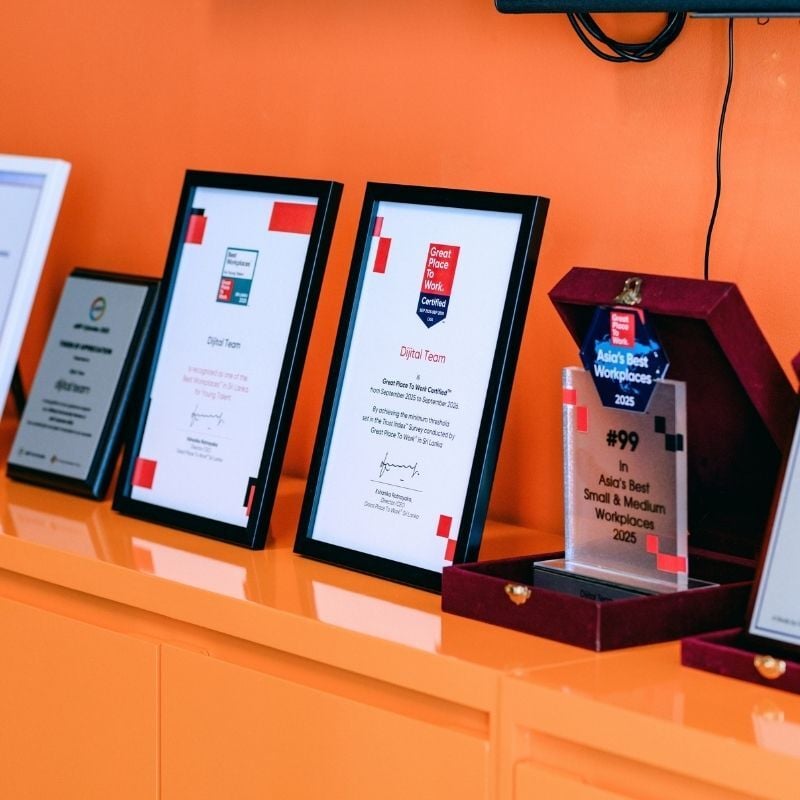
This approach has been independently recognised. Great Place to Work ranked Dijital Team as the number two Best Workplace in Sri Lanka’s technology sector for 2026 and number three in its applicable national workplace category.
Dijital Team was also recognised among Asia’s Best Workplaces.
These awards matter because team engagement has a direct impact on customers. A supported employee is more likely to stay, build deeper knowledge, contribute ideas and care about the results they deliver.

Security should be a fundamental part of every offshore decision.
The location of a team does not automatically make an engagement secure or insecure. The provider’s systems, governance, employment controls, infrastructure and working practices determine how effectively customer information is protected.
Sri Lanka has introduced the Personal Data Protection Act and established a national Data Protection Authority responsible for the country’s personal-data protection framework.
Sri Lanka also has intellectual-property legislation covering areas including copyright, patents, trademarks, industrial designs, trade names and undisclosed information.
These legal frameworks provide an important foundation, but customers should still evaluate the controls implemented by the individual offshore provider.
Dijital Team maintains ISO 27001 certification and uses externally audited security controls. Its measures include access controls, employee background checks, logging, encryption, data minimisation and controlled access to customer information.
This provides customers with a structured security framework rather than relying on informal policies or individual employee practices.
Ask the provider about:
Reliable connectivity is essential for an offshore team.
Sri Lanka is connected to international networks through multiple submarine cable systems. The SEA-ME-WE 6 system landed in Sri Lanka in December 2024 and was designed with a total system capacity of 130 Tbps, supplementing the country’s existing international cable connections.
Dijital Team provides the equipment and infrastructure required for each team member to perform their role. Team members are supported with business-grade connectivity, managed equipment and power-continuity measures so that temporary local issues do not become customer disruptions.
Customers can also use Dijital Team’s secure facilities in Colombo and Kandy at no additional cost, giving the business access to talent across more than one Sri Lankan employment market.
Dijital Team ensures resilience at the team-member and provider level through:
For businesses looking to build dedicated offshore teams rather than simply outsource tasks, Sri Lanka has become one of the best-kept secrets in the global technology industry.
Sri Lanka can support a broad range of technical and operational positions. The right first role depends on the greatest constraint within your business.

Sri Lankan service-desk professionals can support end users, troubleshoot incidents, manage requests and work within the customer’s PSA, RMM and documentation platforms.
Common positions include:

Businesses can recruit professionals with experience across Microsoft cloud, hybrid infrastructure, networking and modern workplace technologies.
Common positions include:

Sri Lanka’s expanding technology sector includes professionals working across security operations, compliance, engineering and testing.
Common positions include:

For MSPs, automation is increasingly becoming a core operational capability.
Sri Lankan automation professionals can help integrate systems, remove repetitive work and improve consistency across service delivery.
Common positions include:

Sri Lanka has an established software-development community supporting local and international businesses.
Common positions include:

Businesses can use Sri Lankan talent to strengthen reporting, data engineering, analytics and AI-enabled solutions.
Common positions include:

Offshoring does not need to begin with a technical position. In many businesses, operational bottlenecks exist in finance, procurement, administration or sales support.
Common positions include:
Sri Lanka is particularly well suited to businesses that want the eight things on the checklist.
Tick the ones that matter to your business to see how well Sri Lanka fits.
Tick what matters to your business
Choosing Sri Lanka is only the first decision. The next is choosing the right offshore partner.
Dijital Team specialises in designing and building dedicated offshore teams for MSPs, IT service providers, system integrators, software companies and technology businesses.
We do not provide a shared outsourced service. We recruit a person specifically for your position and embed them into your business.

Dijital Team does not carry a bench and does not push the next available candidate into your organisation.
We begin by understanding:
We then develop the position, search the Sri Lankan talent market and present candidates who have completed our assessment process.
You interview and approve the person before they join your business.
Select a point to see how Dijital Team supports you and your team member.
Candidates can be evaluated through a combination of:
Talent-acquisition screening
Recorded communication assessment
Technical testing
Behavioural and cultural assessment
Subject-matter expert interviews
Reference and background checks
Customer interviews
This process is designed to evaluate the whole person rather than relying only on a resume.
Our pricing includes the core employment and support costs required to create a sustainable offshore position. There are no surprise thirteenth-month charges, unexpected foreign-exchange fees or separate invoices for essential equipment and employee support.
Dijital Team operates from secure locations in Colombo and Kandy, enabling us to access talent across multiple employment markets and provide facilities for training, collaboration and customer visits.
Our workplace culture has been recognised by Great Place to Work in Sri Lanka and Asia. These achievements reflect our commitment to creating an environment in which people can build meaningful careers and deliver exceptional outcomes for customers.
Your team member works directly with you, but you are not left to manage the offshore journey alone.
Dijital Team supports customers with onboarding, performance reviews, team engagement, development planning, workplace matters and ongoing optimisation.
Building a successful offshore team should be a structured business initiative rather than an isolated recruitment exercise.
Determine whether the greatest challenge is capacity, skills, cost, service coverage, process maturity or an inability to complete strategic work.
Your first offshore hire does not need to be the most junior position. Choose the role that will create the greatest measurable impact.
Document required outcomes, responsibilities, technologies, experience, communication expectations, working hours and performance measures.
Search the market for candidates aligned with the position rather than selecting from a generic bench.
Use structured testing and interviews to validate each candidate’s suitability.
The final hiring decision remains with you.
Explain why the role is being created, how responsibilities will be shared and how the new employee will be integrated.
Provide system access, documentation, training, introductions and clearly defined expectations.
Track performance through operational metrics, quality, customer feedback, capacity created and financial results.
Once the operating model is working, add complementary roles and develop leadership capacity within the offshore team.
Dijital Team can generally present assessed candidates quickly, with many successful team members able to commence in approximately 35 days depending on availability and notice periods.
When MSPs evaluate offshore locations, they typically compare Sri Lanka against India, the Philippines, Eastern Europe, and South Africa.
The reasons they increasingly choose Sri Lanka include:
Strong English proficiency and customer-facing communication skills.
Lower turnover creates greater stability.
Access to engineers working with today's technology stack.
Easy integration with Western businesses.
Excellent overlap with Australia, New Zealand, and the UK.
Ideal for dedicated team models rather than transactional outsourcing.
When Dijital Team was founded, we evaluated multiple offshore destinations.
We chose Sri Lanka because we believed it offered the strongest combination of:
Today, hundreds of technology professionals support MSPs and IT service providers across Australia, New Zealand, the United Kingdom, and beyond.
We have seen firsthand how Sri Lankan professionals help businesses increase capability, improve profitability, strengthen customer experience, and accelerate growth.
Select a point to see why it mattered to us.
Yes. Sri Lanka is a strong outsourcing and offshore staffing destination for businesses seeking skilled professionals, competitive costs, English business communication and long-term dedicated teams. It is particularly well suited to IT, software, finance, data, engineering and professional-services roles.
Yes. Thousands of international organisations successfully operate in Sri Lanka. Modern technology businesses have mature security, compliance, and business continuity practices.
Yes. Many professionals have extensive experience working within MSPs, service desks, project teams, cybersecurity operations, and cloud environments.
Sri Lanka has an established technology ecosystem, university and professional education pathways, international technology exposure and a growing ICT export sector. Businesses can recruit professionals across cloud, infrastructure, cybersecurity, software development, automation, data and technical support.
English proficiency is one of Sri Lanka's strongest advantages and is widely used across education, business, and technology sectors. English is Sri Lanka’s constitutional link language and is commonly used across private-sector business, technology and higher education. Individual communication ability varies, so every candidate should be assessed for spoken English, written communication, comprehension and customer-service aptitude.
Absolutely. Many organisations use Sri Lankan team members in customer-facing service desk, project, consulting, and support roles.
Savings vary according to the position, experience level, employment model and onshore comparison. Dijital Team uses a four-to-one value rule as an initial planning guide, meaning the fully loaded cost may be around one quarter of the equivalent local employment cost for some roles.
The objective should be sustainable value rather than selecting the lowest-priced provider.
Yes. Sri Lankan professionals can work schedules aligned with Australian businesses. Because Sri Lanka is 4.5 hours behind AEST and 5.5 hours behind AEDT, Australian coverage normally requires an early Sri Lankan shift.
These hours should be agreed upon before recruitment.
Yes. Sri Lanka is 4.5 hours ahead of the United Kingdom during British Summer Time and 5.5 hours ahead during Greenwich Mean Time. This creates useful working-day overlap between Sri Lankan and UK teams.
Common positions include service-desk engineers, cloud engineers, cybersecurity professionals, automation engineers, software developers, quality-assurance specialists, data engineers, bookkeepers, procurement staff, sales administrators and customer-success professionals.
Data security depends primarily on the provider’s controls. Sri Lanka has personal-data protection legislation and a national Data Protection Authority, but customers should also assess provider certification, access controls, endpoint security, data-loss prevention, background checks and incident-response practices.
Dijital Team maintains ISO 27001 certification.
Sri Lanka’s Intellectual Property Act covers copyright, patents, trademarks, industrial designs, trade names and undisclosed information. Businesses should also ensure their provider uses appropriate employment agreements, confidentiality provisions, customer contracts and access controls.
Sri Lanka is connected to multiple international submarine cable systems, including SEA-ME-WE 6. Reliability still depends on the employee’s local connectivity and the provider’s resilience measures.
Dijital Team supports team members with managed equipment, business-grade connectivity and power-continuity measures.
Each market has different strengths. India and the Philippines have much larger outsourcing industries and may be preferable for very large operations.
Sri Lanka can be particularly attractive for businesses building smaller dedicated teams that require technical capability, direct management, long-term integration and competitive costs.
Traditional outsourcing transfers responsibility for a process or outcome to an external supplier. The supplier normally manages the employees, workflow and service.
With dedicated offshore staffing, the team member works within your organisation. You direct their daily priorities, include them in your meetings and manage them as part of your existing team while the offshore provider handles local employment and support.
The timeframe depends on the complexity of the role and candidate notice periods. Dijital Team can often present assessed candidates within a week, with many team members able to commence in approximately 35 days.
Depending on the role and skillset, businesses can often scale significantly faster than relying solely on local recruitment markets.
Not necessarily. Your first offshore position should address the greatest constraint in your business. This may be an L2 Engineer, automation specialist, developer, bookkeeper, procurement professional or another experienced role.
Include them in your organisation. Provide clear objectives, regular feedback, recognition, training, career pathways and access to company meetings. Offshore team members should have the same sense of purpose and belonging as onshore employees.
Whether you need a service desk engineer, project specialist, automation expert, cybersecurity professional, software developer, or an entire delivery team, Sri Lanka provides access to the skills required to help your business scale.
Talk to Dijital Team about how to build a dedicated offshore team that becomes a seamless extension of your business and helps you create a better IT company for the future.