




The Ultimate Guide to
MSP Growth

How Managed Service Providers and IT Service Providers can win better customers, increase recurring revenue, create capacity and build a more scalable, profitable and valuable business

Growing a Managed Service Provider sounds straightforward.

Win more customers. Increase monthly recurring revenue. Sell additional services. Hire more people.

But as most MSP owners discover, revenue growth and business improvement are not the same thing.

More customers create more tickets. More tickets create additional demand on the service desk. Larger customers have greater expectations. New services require new skills. Project backlogs increase and managers spend more time resolving operational issues. And businesses that were relatively simple at $2 million or $3 million in revenue can become considerably more complex at $5 million or $10 million.

An MSP can therefore grow revenue while becoming less profitable, less scalable and more dependent on its owner.

The objective should be something better.
Peter Ward

Sustainable MSP growth is the ability to increase recurring revenue, customers, capability and enterprise value without increasing cost, complexity and owner dependency at the same rate.

The latest Service Leadership data shows why that distinction matters. MSP revenue growth rebounded to 9.6% in 2025, but adjusted EBITDA dollars grew considerably faster, at 17.1%. Best-in-class IT solution providers also sustained adjusted EBITDA profitability above 19% for the sixth consecutive year. The lesson is not simply that MSPs can grow. It is that the strongest businesses can make growth increasingly efficient.

At the same time, the market is becoming harder to navigate. Kaseya's 2026 State of the MSP report found 71% of more than 1,000 MSP respondents saw acquiring new customers as their biggest challenge. Customer spending is under pressure, buyers want clearer proof of value and skilled technical talent remains difficult to find.

So the real question for an MSP owner is no longer:
How do we get bigger?

It is:
How do we build a business that becomes stronger as it grows?

Executive Summary


Sustainable MSP growth is created by a system, not a single sales initiative.

The strongest growth model combines six things.

01
Positioning

Choosing the customers and problems where the MSP can create distinctive value.

02
Customer Acquisition

Building a repeatable combination of inbound, outbound, referrals, partnerships and thought leadership rather than relying on opportunities to arrive unpredictably.

03
Retention and Expansion

Protecting recurring revenue already won and systematically identifying additional problems the MSP can solve for existing customers.

04
New Capability

Moving into growing categories such as cybersecurity, automation, AI, co-managed IT and business-process improvement.

05
Delivery Leverage

Ensuring additional revenue does not require additional headcount at exactly the same rate. That requires standardisation, automation, the right capacity mix and deliberate workforce planning.

06
Leadership Discipline

Turning growth from something dependent on the founder and several heroic employees into something managed through people, systems, metrics and accountability.

These levers reinforce one another.

Better positioning attracts better-fit customers. Better customers are easier to standardise and support. Better service improves retention. Retention strengthens recurring revenue. Expansion increases revenue per customer. Automation creates capacity. Stronger margins fund additional capability and sales investment.

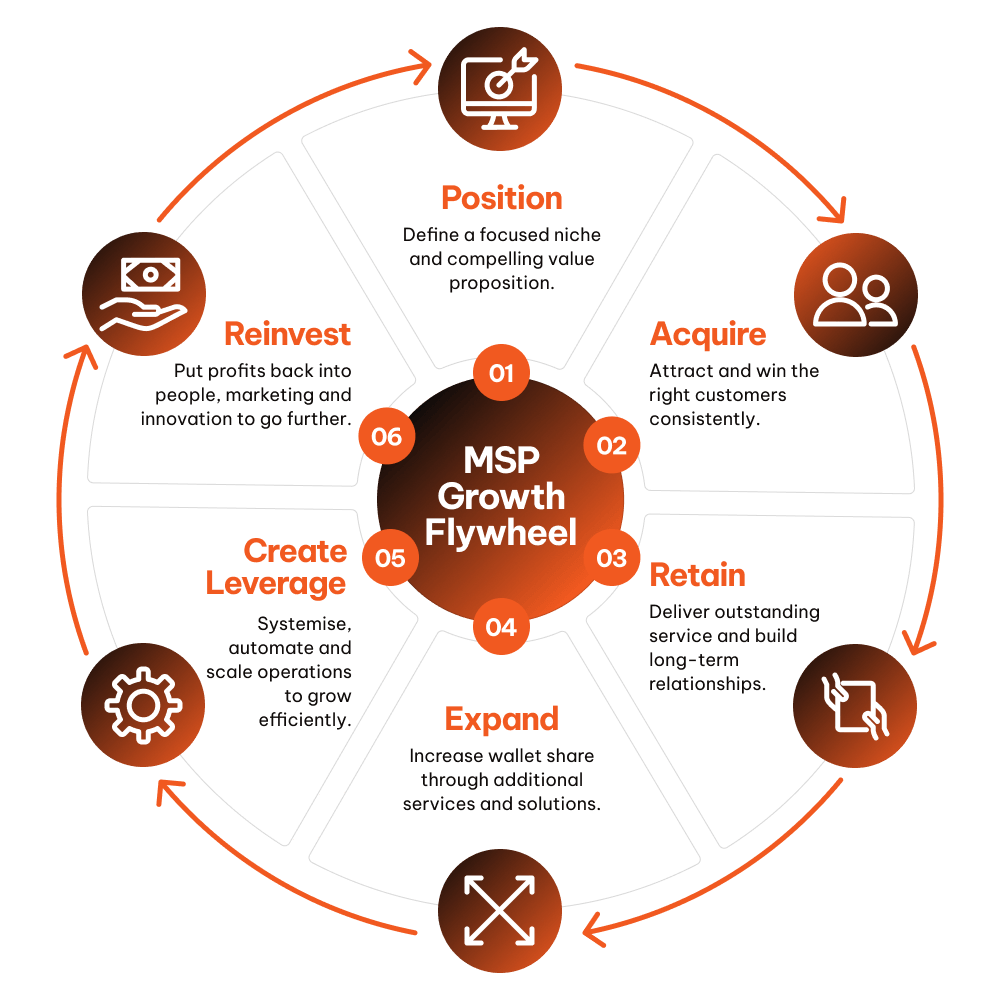
That is the MSP growth flywheel.

MSP Growth Flywheel

Positioning, customer acquisition, retention, expansion, operational leverage and reinvestment compound growth over time

And once it begins working properly, growth becomes increasingly repeatable rather than increasingly stressful.

What MSP Growth Actually Means


Revenue is the most obvious measure of MSP growth.

It should not be the only one.

Consider two MSPs that each grow revenue by 20%.

The first adds people at roughly the same rate as revenue, experiences more escalations, sees service quality become inconsistent and requires the owner to become more involved in operations.

The second grows revenue while standardising customers, automating repetitive work, strengthening Level 2 capability, protecting margins and developing managers who can make decisions without the founder.

Both businesses became larger.

Only one became more scalable.

Dijital Team - Australia Team

Growth quality matters as much as growth rate


A healthier definition of MSP growth includes four dimensions:

Commercial growth

New customers, recurring revenue, account expansion and pipeline.

Operational growth

The ability to support additional customers without service quality deteriorating.

Capability growth

Access to the technical, commercial and management skills required to offer increasingly valuable services.

Financial growth

Stronger gross profit, EBITDA, cash generation and ultimately enterprise value.

The core growth metrics every MSP should track


An MSP growth dashboard should make it possible to see whether the business is growing and whether growth is healthy.

Start with recurring revenue growth, new recurring revenue, expansion revenue, customer contraction and churn. Add pipeline value, conversion rate and average new-customer value.

Then connect commercial measures to service performance: ticket demand, first-contact resolution, escalation volume, project backlog, utilisation where relevant, capacity and customer satisfaction.

Finally, connect all of those measures to service gross margin, EBITDA, revenue per employee and cash.

No single metric tells the story.

Revenue can rise while retention deteriorates. Pipeline can increase while the service desk has no capacity to onboard the wins. Headcount can grow while automation opportunities remain untouched.

A good growth dashboard makes those relationships visible early enough to act.

Dijital Team - Australia Team

The State of MSP Growth


There is substantial opportunity in the MSP market, but it is no longer enough to simply offer a broad menu of technology services.

Kaseya's 2026 research shows the commercial pressure clearly. Seventy-one percent of MSPs identified acquiring customers as their biggest challenge. The share reporting typical annual customer spend above $25,000 fell from 75% to 41%, while 19% reported difficulty demonstrating value quickly to prospects. Difficulty recruiting skilled technicians increased from 9% to 16%.

At the same time, Service Leadership's data shows that well-run MSPs are capable of improving both growth and profitability. Total MSP revenue increased in 2025 and adjusted EBITDA dollars also increased. Service Leadership attributed the industry's emerging economics to factors including scale, automation and operational execution.

New demand is also emerging.

Kaseya found AI and automation were the top customer IT needs, identified by 48% of MSP respondents in 2026, yet just 13% were generating meaningful revenue from them. Cybersecurity was already producing year-over-year revenue growth for 71% of respondents and BCDR for 50%. 

Dijital Team - Australia Team

GTIA's channel research points in a similar direction. 77% percent of North American IT service providers expect AI services and cybersecurity to be among their leading revenue-growth categories over the next two years. Separately, GTIA's 2025 US SMB research found 65% of SMBs regard technology as a primary contributor to business goals and 80% say there is at least some room to improve their technology strategy. That US buyer research should be treated directionally for an Australia, New Zealand and UK audience, but the strategic implication is useful: customers increasingly need providers that can connect technology to business performance.

The growth opportunity is therefore changing.

The traditional value proposition was:
We manage your IT.

The next-generation proposition is broader:
We understand your technology and your business, and we help you become more secure, productive, efficient and competitive.

That is a much larger opportunity.

Dijital Team - Sri Lanka Team

The MSP Growth Flywheel


MSP growth is often treated as a funnel. Generate leads. Close deals. Repeat.

A flywheel is a better model because the customer relationship itself should contribute to future growth.

Position icon
Position

Define the market you understand best and the problems where you can create differentiated value.

Acquire icon
Acquire

Build predictable sources of qualified opportunities and convert the right prospects.

Retain icon
Retain

Deliver consistently enough that recurring revenue remains in the business.

Expand icon
Expand

Use customer knowledge to identify additional security, automation, cloud, data, advisory and business-improvement opportunities.

Create Leverage icon
Create leverage

Standardise, automate and build the right capacity so revenue can increase faster than operating complexity.

Reinvest icon
Reinvest

Use the resulting margin and cash flow to invest in marketing, leadership, people, technology and new capability.

The flywheel becomes powerful because each stage improves the next.

Strong retention means less new sales activity is wasted replacing churn. Better customer fit makes delivery easier to standardise. Better delivery creates stronger references. Automation creates capacity before the next customer arrives. New specialist capabilities create additional expansion revenue.

Growth begins to compound.

Choose better customers and sharpen positioning


One of the most important growth decisions an MSP can make is deciding who it does not need to serve.

Many providers grow organically. A referral becomes a customer. Another referral arrives. Different industries, applications, technologies and expectations gradually accumulate until the MSP is supporting dozens of variations of essentially the same service.

Every variation creates operational cost.

A clearer Ideal Customer Profile reduces that complexity.

Define the ideal customer profile

An effective MSP ICP should go further than employee count.

Consider industry, geography, technology maturity, security requirements, management expectations, willingness to standardise, internal IT capability, likely service breadth and growth trajectory.

Ask which customers are genuinely easiest to create value for.

Then analyse your existing base. Which customers have strong margins? Which adopt your recommendations? Which generate referrals? Which buy multiple services? Which consume disproportionate support?

Your best target customer is not necessarily the largest. It is the one where your commercial model and delivery model fit.

Vertical specialisation can strengthen that fit further. An MSP that understands legal, accounting, financial services, construction or another market can speak about workflow, regulation, productivity and business risk rather than only infrastructure.

Sell business outcomes, not technology

Most buyers do not fundamentally want another RMM tool, backup platform or firewall.

They want reduced risk, less downtime, more productive employees, predictable technology costs and confidence that the business can grow.

GTIA's 2025 US SMB research found growth and efficiency were prominent business priorities, while only 19% of respondents believed their organisations excelled at technology vision and strategy. 61% percent reported outsourcing IT services either regularly or occasionally. Again, those figures are US-specific, but they illustrate the strategic-advisor opportunity available to IT service providers.

The more an MSP can connect technology to those outcomes, the less interchangeable its proposition becomes.

Build a predictable customer acquisition engine


Referrals are valuable.

They are not predictable.

Referrals, vendor introductions and inbound leads can produce excellent opportunities, but an outbound system gives an MSP more control over which accounts it targets and when pipeline is created. It recommends starting with the ICP and business outcomes rather than selecting tools first.

A mature growth engine should combine channels.

Inbound, SEO and authority

Search allows an MSP to become useful before a prospect is ready to buy.

That means creating content around the questions ideal customers actually ask rather than merely publishing pages describing services.

For example:

How should an accounting firm prepare for Microsoft Copilot?

What cybersecurity controls does a law firm need?

How can a growing business automate employee onboarding?

What should a business include in a cyber-resilience plan?

How can a professional-services company use AI safely?

The provider answering these questions becomes part of the customer's decision-making process before a sales conversation begins.

Modern outbound

Outbound complements inbound because it lets the MSP deliberately select target organisations.

Build lists around the ICP. Identify triggers such as hiring, expansion, new locations, compliance changes or technology projects. Use email, phone, LinkedIn, events and partnerships as coordinated touchpoints.

Most importantly, lead with relevance.

The opportunity is to move the conversation from technical language toward growth, risk, compliance, downtime and operating efficiency, while warning that successful demand generation must be matched by the delivery capacity to absorb new customers.

That final point is critical.

The sales plan and the capacity plan should be the same plan.

Retain customers and expand recurring revenue


A new customer adds growth.

A customer that leaves subtracts from it.

This makes retention one of the most powerful growth levers in a recurring-revenue business.

Imagine an MSP starts with $5 million of recurring revenue and loses $500,000. Sales must first replace that $500,000 before the business creates any net growth.

The objective should therefore be to turn customer success into a commercial system.

Set expectations clearly during sales. Build structured onboarding. Measure satisfaction. Develop relationships beyond the operational contact. Identify renewal risk early. Create account plans.

Most importantly, make strategic reviews useful.

A QBR should not simply show how many tickets were opened and closed.

Ask:

What is changing in the customer's business?

Where are employees losing time?

What new risks are emerging?

What processes could be automated?

Where might AI create value?

What investments will be required over the next twelve to twenty-four months?

That moves the conversation from technology maintenance toward business improvement.

It also creates expansion revenue naturally because the MSP discovers additional problems worth solving.

Build new revenue streams


One of the fastest ways to grow an MSP is to increase the number of valuable problems it can solve.

Cybersecurity remains an obvious example. 71% percent of Kaseya's 2026 MSP respondents reported year-over-year cybersecurity revenue growth, while 50% reported growth from BCDR.

Co-managed IT extends the addressable market further. Kaseya's 2025 benchmark found 61% of executive respondents reported year-over-year co-managed IT revenue growth. Instead of asking an organisation to replace its internal IT function, the MSP can provide specialist security, projects, cloud, after-hours support, automation or service-desk capacity around it. 

Dijital Team - Sri Lanka Team
AI, automation and business improvement

AI and automation may represent the most important emerging service opportunity.

There is a striking commercialisation gap: 48% of Kaseya's 2026 respondents identify AI and automation as customers' leading need, yet just 13% say those services already generate meaningful revenue.

The answer is not to create a vague “AI service”.

Where does the customer's team repeatedly enter information?

Where do highly paid employees perform administrative work?

Where does information need to move between systems?

Where are customers waiting unnecessarily?

What workflow occurs hundreds or thousands of times each month?

Then determine whether AI, APIs, Power Platform, conventional automation or software development is the right solution.

Begin with the customer's workflow and measurable business outcome, then select the technology. It also identifies an opportunity for MSPs to build recurring AI and continuous-improvement services around an evolving backlog of processes.

This takes the MSP further up the value chain.

Create delivery leverage


The most dangerous point in an MSP growth cycle is when sales success outruns delivery capacity.

Hiring after the service desk is already overloaded is reactive.

The alternative is capacity planning.

Monitor the sales pipeline alongside user counts, ticket trends, project backlog, escalation volume, specialist requirements and available capacity.

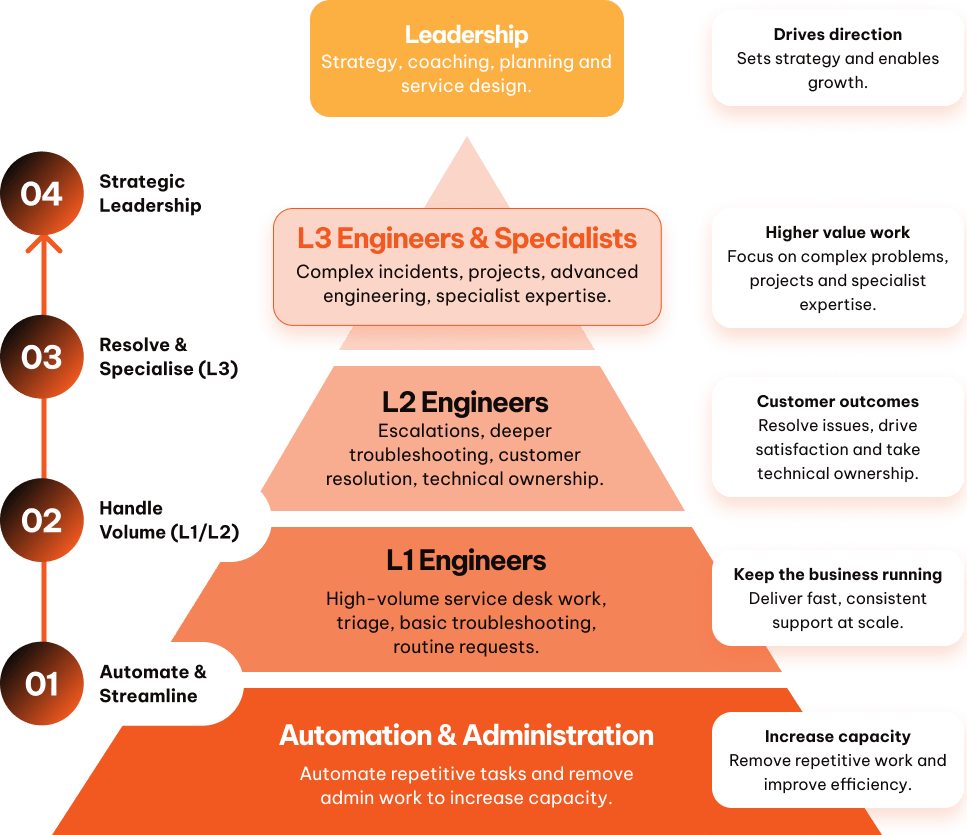
Sustainable scale comes from putting the right work with the right role rather than continually demanding more from the same technicians. Stronger L2 capability, separating project work from reactive support, specialist roles, automation and strategic workforce planning are all part of getting the delivery mix right. 

MSP Growth Capacity Mix

MSP capacity mix showing work allocated across automation, administration, service desk engineers, senior engineers and specialist roles.

Right work. Right capability. Better scalability.

Reduce overload, improve efficiency and build capacity for growth.

Ask a simple question about every major category of work:
Is the most appropriate person doing this task?

If L3 engineers are repeatedly solving basic tickets, capacity is being misallocated.

If senior engineers spend hours on quotes, procurement, license administration and reporting, capacity is being misallocated.

If employees repeatedly perform a rules-based task a machine could execute, capacity is being misallocated.

Growth becomes easier when the organisation releases expensive capability for higher-value work.

Future IT Services Increased CSAT and first-call resolution to 87% and created capacity for up to 250 additional seats.

Use automation to create capacity

Kaseya found 53% of MSPs were already using AI in areas such as ticketing, patching and monitoring in 2026, but more than half had automated only about a quarter of their workload. That suggests the operational opportunity remains substantial.

MSPs should therefore treat their own business as an automation laboratory.
Every successful automation creates internal capacity and practical experience that may later become useful in customer engagements.

A dedicated Automation Engineer can accelerate this because automation ceases to be something technicians work on between tickets.

geezit hired a dedicated offshore automation specialist to accelerate the implementation of Pia and significantly reduced manual effort and freed local employees for client-facing work.

Use global talent to unlock capability

Offshoring should not be framed only as paying less for a role.

For an MSP trying to scale, the more strategically interesting question is:
Can global talent give us access to capacity or specialist capability faster than our existing hiring model?

Dijital Team supports MSPs design and build capability based on the specific requirements; including L2 and L3 engineers, Automation Engineers, Service Delivery Managers, Network Engineers, NOC resources and other technical and business functions like Sales Admins. Our MSP offering is built around dedicated Sri Lankan team members aligned with your operating hours and integrated directly into your business.

That is the objective of capacity design.

Not simply lower cost.

More room to grow.

Build leadership and operating discipline


Eventually, many MSPs hit a constraint that has nothing to do with technology.

The owner.

When customer issues, sales approvals, hiring, technical escalations and financial decisions all flow through one person, the company's capacity becomes linked to the founder's calendar.

Scale requires management capacity as well as technical capacity.

Build clear ownership for service delivery, customers, sales, finance and operations. Establish a regular operating rhythm. Review a small set of meaningful metrics. Identify the biggest constraint. Assign an owner. Resolve it. Repeat.

Discover how the Better Business can help to create structure to ensure sustainable growth and build the whole business capability rather than a pure sales outcome. 

A Practical MSP Growth Plan for the Next Quarter


Trying to transform the entire business simultaneously usually creates more initiatives than execution.

A better approach is to identify the constraint currently limiting growth.

Define the ideal customer profile. Calculate recurring revenue movement. Review customer churn and expansion. Examine pipeline and conversion. Review service capacity, ticket volume and project backlog. Identify which specialist capabilities are missing. Understand where the owner remains a bottleneck.

Then identify the biggest constraint.

Is there insufficient demand?

Poor conversion?

High churn?

Weak expansion?

Not enough delivery capacity?

Too little automation?

A capability gap?

Founder dependency?

If acquisition is the problem, strengthen positioning and build a repeatable inbound/outbound motion.

If customer expansion is weak, redesign QBRs around business outcomes and build account plans.

If delivery capacity is the constraint, redesign work allocation, prioritise automation and establish the next roles required.

If new-service growth is the opportunity, choose one capability—perhaps AI automation, cybersecurity or co-managed IT—and productise a repeatable offer.

Document the process.

Assign ownership.

Build the scorecard.

Review progress weekly.

Measure commercial and operational outcomes together.

Then identify the next constraint.


Growth becomes substantially more manageable when it is treated as a sequence of bottlenecks rather than a hundred priorities.

FAQs About MSP Growth


Next Steps


MSP growth is not a sales problem.
It is a business-design problem.

Better positioning creates better opportunities. Better customers strengthen recurring revenue. Strong retention compounds growth. New capabilities create more valuable services. Automation and the right talent mix create capacity. Stronger margins fund the next stage.

That is how an MSP moves from getting bigger to becoming more scalable, profitable and valuable.

Map the roles, skills and capacity your MSP will need for its next stage of growth.

Build Your MSP Growth & Capacity Plan