
The short version
- 8-12 qualified meetings booked per month is a reasonable starting target for a fully ramped outbound SDR selling to SMB and mid-market customers. Validate it against your own sales data.
- Track three outcomes: meetings booked, meetings held and qualified opportunities. Only the last one measures commercial value.
- Set different targets for different roles, from 4-8 for outbound into larger customers to 12-20+ for inbound with sufficient lead volume.
- Allow a structured 60-90-day ramp-up before you expect the full meeting target.
- Judge an SDR on pipeline quality and value, not calendar volume. Fewer, better meetings can create more than four times the MRR.
You've hired a Sales Development Representative (SDR) to help grow your Managed Service Provider (MSP).
They're making calls, sending emails, connecting with prospects on LinkedIn and updating your CRM.
But after a few weeks, an important question emerges.
How many sales meetings should they actually be booking?
Is five meetings a month acceptable? Should you expect ten? Twenty? Or should a good SDR be booking a meeting every day?
It's a question many MSP owners struggle to answer.
Target too low
Set the target too low, and you risk investing in a sales development function that doesn't generate sufficient return.
Target too high
Set the target too high, and you can create the wrong behaviours: unqualified meetings, poor prospect experiences and a frustrated sales team.
The answer isn't simply a number.
It depends on whether your SDR is generating inbound or outbound opportunities, the size of your ideal customers, the complexity of your sales process and, most importantly, the quality of the meetings being generated.
Let's explore what realistic SDR targets look like and how MSPs should measure sales development performance.
How many meetings should an MSP SDR book per month?
For an MSP targeting small to mid-sized businesses, 8-12 qualified meetings booked per month is a reasonable initial planning target for a fully ramped, outbound-focused SDR.
This isn't a universal industry benchmark specifically measured across MSPs. It's a practical starting point that should be validated against your own sales data.
Suggested MSP outbound SDR monthly targets
Developing4-7Meetings booked
On target8-12Meetings booked
Strong13-16+Meetings booked
But there's an important distinction.
Booking 12 meetings does not mean delivering 12 qualified sales opportunities.
Some prospects won't attend. Others won't match your ideal customer profile. Some will attend simply to learn more, with no realistic intention of changing IT providers.
This is why successful MSPs should measure more than the number of meetings placed in a calendar.
What do broader SDR benchmarks tell us?
Published B2B sales development research provides some useful context.
The Bridge Group's 2025 sales development study, covering 351 B2B organisations, reported a median monthly quota of approximately 10 held introductory meetings, with differences depending on qualification requirements. Secondary summaries of the study also report a median of six converted opportunities.
More recent benchmark compilations suggest that SDR meeting expectations vary substantially between inbound, outbound, SMB and enterprise-focused sales motions.
These benchmarks can help establish an initial target, but they should not be treated as definitive MSP industry averages.
An SDR selling low-cost software subscriptions to small businesses operates in a very different environment from someone selling a $5,000-per-month managed services agreement involving cybersecurity, operational risk and a potential change of IT provider.
The commercial value and complexity of the opportunity must influence the target.
Why MSP SDR meeting targets are different
Managed services can be a particularly challenging offering to prospect for.
Unlike a discretionary software purchase, changing IT providers can be a significant business decision.
A prospect may need to consider:
- The risks associated with switching providers.
- Existing managed services contract commitments.
- The cost and complexity of technology transition.
- Cybersecurity and data protection requirements.
- Internal stakeholder approval.
- Confidence in a new provider's technical capability.
- The potential disruption to business operations.
There is also another challenge.
Most businesses aren't actively looking for a new IT provider at any given moment.
They may be relatively satisfied with their current provider, even if that provider isn't delivering exceptional value.
This means your SDR often needs to create an opportunity for a conversation before a prospect has an immediate requirement.
For an MSP, a meaningful conversation with a well-matched prospect can be significantly more valuable than multiple meetings with businesses that are never likely to become customers.
What counts as a qualified MSP sales meeting?
This is arguably the most important question in the entire sales development process.
Without a clear definition, meeting targets become meaningless.
Imagine your SDR books 15 meetings in a month.
On the surface, that looks like an excellent result.
But when your BDM attends those meetings, they discover that:
- Five businesses are too small to meet your minimum service requirements.
- Three are only interested in a one-off IT support job.
- Two have no influence over purchasing decisions.
- Three are simply gathering information with no clear potential fit.
- Two are genuine opportunities worth exploring.
Your SDR technically booked 15 meetings.
But your sales team received only two potentially valuable opportunities.
That is not necessarily an effective sales development function.
A five-point qualification framework for MSPs
A meeting should generally meet the following criteria before being classified as qualified.
| Qualification criteria | What your SDR should establish |
|---|---|
| 1Ideal Customer Profile | Does the business match your target size, geography and industry? |
| 2Business relevance | Is there a credible IT challenge, improvement opportunity or business reason to talk? |
| 3Appropriate stakeholder | Is the attendee a decision-maker, influencer or relevant participant in the buying process? |
| 4Commercial potential | Could the organisation realistically become a profitable managed services customer? |
| 5Meeting commitment | Has the prospect agreed to a genuine discovery conversation with a clear purpose? |
A prospect doesn't necessarily need an immediate requirement to change IT providers.
For example, an organisation with 120 employees that is approaching a managed services contract renewal in nine months could be an excellent opportunity to nurture.
However, that should be distinguished from an opportunity ready to enter your active sales pipeline.
The SDR's responsibility is to identify and qualify potential opportunities, not simply fill a salesperson's diary.
Related readingHow to create a high-converting MSP sales qualification processBooked meetings vs held meetings vs sales opportunities
A mature MSP should track three separate outcomes.
-
Meetings bookedQualified prospects agree to an appointment
-
Meetings heldProspects attend and complete the meeting
-
Qualified sales opportunitiesPotential deals accepted into the pipeline
In this example, the SDR booked 12 meetings, 10 were held and five became qualified sales opportunities.
An MSP that only tracks meetings booked would miss half the story.
This leads to a key principle:
- Meetings booked measure activity.
- Meetings held measure engagement.
- Qualified opportunities measure commercial value.
All three matter, but they should not carry equal importance.
Inbound vs outbound SDRs: should the targets be different?
Absolutely.
One of the most common mistakes MSPs make is expecting the same meeting volume from SDRs performing fundamentally different activities.
Inbound SDR
An inbound SDR typically follows up with prospects who have already engaged with the business through website enquiries, events, referrals or marketing campaigns.
Some have an immediate requirement, while others need further qualification or nurturing.
Because there is already some level of engagement, an inbound SDR can often generate more meetings than someone conducting entirely cold outbound prospecting.
However, performance depends heavily on the number and quality of inbound leads available.
Outbound SDR or BDR
An outbound SDR or Business Development Representative (BDR) proactively identifies and engages businesses that may not be actively looking for a new IT provider.
This often requires more research, relationship-building and follow-up before a meeting is secured.
A useful starting framework is:
| Sales development role | Suggested monthly meetings booked |
|---|---|
| Outbound SDR targeting larger MSP customers |
4-8
|
| Outbound SDR targeting SMBs |
8-12
|
| Hybrid inbound/outbound SDR |
10-15
|
| Inbound SDR with sufficient qualified lead volume |
12-20+
|
These are suggested planning ranges rather than verified MSP-specific industry benchmarks. Actual expectations should reflect lead supply, market size, average contract value and qualification standards.
The important consideration is whether the opportunities are commercially valuable.
An SDR targeting businesses with 200-500 employees may generate fewer meetings than someone targeting businesses with 20-50 employees.
But a single large managed services agreement may be worth considerably more.
Related readingHow to Build an MSP Outbound Sales EngineHow many calls does an MSP SDR need to make to book meetings?
This is another common question.
If you want your SDR to book 10 qualified meetings per month, how much prospecting activity is required?
The answer depends on the quality of your target list, the relevance of your message, the communication channels used and the SDR's ability to engage decision-makers.
Rather than imposing an arbitrary requirement for 100 calls per day, start by understanding your sales funnel.
Example outbound prospecting model
Let's use a simplified, hypothetical outbound model.
| Monthly activity | Example outcome |
|---|---|
| Prospecting calls made | 600 |
| Meaningful conversations | 60 |
| Qualified meetings booked | 12 |
| Meetings held | 10 |
| Sales opportunities generated | 5 |
In this scenario:
- 10% of calls result in meaningful conversations.
- 20% of conversations result in meetings booked.
- Approximately 83% of booked meetings are held.
- 50% of held meetings become qualified sales opportunities.
These are modelling assumptions, not a claim about typical MSP SDR conversion rates.
The benefit of understanding these relationships is that you can identify where performance needs improvement.
Find where your SDR funnel leaks
Pre-filled with the example model. Enter one month of your SDR's numbers to see which stage falls furthest below it.
Enter a whole number.
Enter a whole number.
Enter a whole number.
Enter a whole number.
Enter a whole number.
Calls to conversationsExample model: 10%
Conversations to meetings bookedExample model: 20%
Booked meetings heldExample model: approximately 83%
Held meetings to opportunitiesExample model: 50%
Every stage is at or above the example model.
Calls, but few conversations
If your SDR makes plenty of calls but generates few conversations, you may have a problem with your contact data, calling times or targeting.
Conversations, but few meetings
If conversations are happening but meetings aren't being booked, you may need to improve the messaging, value proposition or objection handling.
Meetings, but few opportunities
If meetings are being booked but few convert into opportunities, your qualification criteria may need attention.
The objective isn't to maximise the number of calls. It's to improve the conversion of sales activity into profitable opportunities.
What should an MSP SDR's monthly KPIs look like?
A good SDR scorecard should balance activity, engagement quality and commercial results.
Here's an example for a fully ramped outbound SDR supporting an MSP targeting small and medium-sized businesses.
Example MSP SDR KPI scorecard
| KPI | Illustrative monthly target |
|---|---|
| Prospecting calls | 400-600 |
| Meaningful prospect conversations | 40-60 |
| Qualified meetings booked | 8-12 |
| Meeting attendance rate | 80%+ |
| Qualified meetings held | 7-10 |
| Meeting-to-opportunity conversion | 40-60% |
| Sales opportunities created | 3-6 |
| CRM data accuracy and follow-up compliance | 95%+ |
These figures are proposed starting targets, not independently validated MSP benchmarks. They should be adjusted based on actual results, and activity expectations must reflect the time needed for research, coaching, administration and other channels.
The five KPIs that matter most
- 1
Qualified meetings booked
A useful leading indicator of whether your SDR is generating prospect interest.
- 2
Meetings held
Measures whether prospects are genuinely engaging and attending their appointments.
- 3
Meeting-to-opportunity conversion
Indicates whether SDRs are qualifying appropriately and generating commercially relevant opportunities.
- 4
Return on investmentQualified pipeline value
Measures the potential recurring revenue being created by the SDR's activities.
- 5
Return on investmentSDR-sourced new MRR
Connects sales development performance to actual business growth.
The last two measures are particularly important for understanding return on investment, although they should be assessed over an appropriate period because managed services sales cycles can extend across several months.
Related reading10 KPIs Every MSP Sales Team Should TrackThe real question: how much MRR should an MSP SDR generate?
Meetings are a means to an end.
The real objective is acquiring profitable customers.
Let's consider two MSP SDRs.
| Performance metric | SDR A | SDR B |
|---|---|---|
| Qualified meetings held/month | 15 | 8 |
| Meetings converted to opportunities | 30% | 60% |
| Opportunities won | 20% | 30% |
| Average customer MRR | $1,500 | $4,000 |
| Expected new MRR/month | $1,350 | $5,760 |
Compare SDR A and SDR B by
SDR A
SDR B
SDR A delivers almost twice as many meetings.
But SDR B's meetings are better qualified, convert at a higher rate and generate more valuable customers.
Despite holding fewer meetings, SDR B creates more than four times the expected monthly recurring revenue.
This is why meeting volume should never be the only measure of success.
It is also important to recognise that the SDR doesn't directly control every stage of this process.
The BDM's ability to conduct discovery, prepare proposals, position value and close opportunities plays a major role.
SDR performance should be evaluated based on the quality of pipeline sourced, alongside downstream outcomes that reflect the effectiveness of the broader sales team.
MSP SDR meeting-to-revenue calculator
The following calculator demonstrates how meeting volume, conversion rates and customer value affect the commercial outcome of an SDR's activity.
MSP SDR Performance Calculator
Adjust the assumptions to understand the relationship between SDR meeting targets and recurring revenue.
Load an example from the SDR A and SDR B table:
New MRR/month
$3,600
1.2 expected customers a month at $3,000 MRR each
- Expected meetings held
- 9.6
- Expected opportunities
- 4.8
- Expected customers/month
- 1.2
- New MRR/month
- $3,600
- SDR cost per expected customer
- $4,167
- Annualised revenue from one month's wins
- $43,200
This is an illustrative steady-state model. Fractional customers represent expected averages, not individual monthly wins. Assumes immediate billing and no churn; excludes sales cycle timing and any sales management, commission or acquisition costs not included in the monthly SDR cost.
This highlights why small improvements in qualification and conversion can have a substantial impact on revenue.
Rather than focusing exclusively on getting an SDR from 10 to 15 meetings per month, an MSP may achieve a better outcome by improving the quality of meetings already being generated.
Related readingHow much does it cost to acquire a new MSP customer?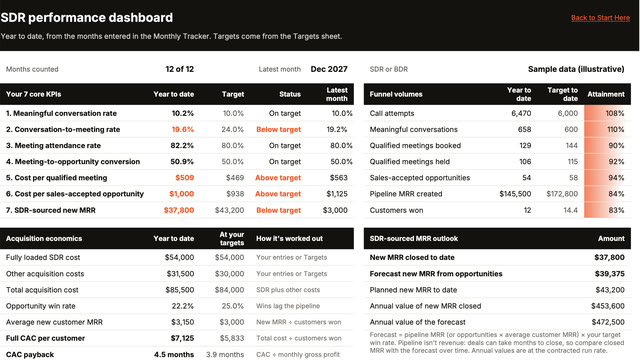
Free calculator
Is your SDR delivering pipeline, or just activity?
Set monthly activity and meeting targets, track attendance and qualification rates, forecast SDR-sourced MRR and see your customer acquisition cost and payback.
- 6worksheets
- 7core KPIs
- 12months tracked
- 1ROI calculator
How long should an MSP SDR take to reach their meeting target?
Expecting a new SDR to achieve full productivity in their first month is often unrealistic, particularly when they are new to the MSP industry.
Sales development involves more than learning a script.
The SDR needs to understand your ideal customer profile, the business problems you solve, your differentiation, common objections and the commercial realities of managed services.
They also need time to build a prospecting pipeline.
A practical 90-day SDR ramp-up plan
| Period | Primary focus | Indicative meeting target |
|---|---|---|
| Month 1 | Training, ICP research, CRM, messaging and initial outreach | 2-4 |
| Month 2 | Consistent prospecting, coaching and qualification | 5-7 |
| Month 3 | Improved conversions and established prospecting rhythm | 8-12 |
These targets are suggested for an outbound-focused SDR. Inbound roles with strong existing lead volume may ramp faster, while specialist enterprise-focused roles may require longer.
The Bridge Group's 2025 research reported a median SDR ramp period of approximately three months across its broader B2B sample, providing some support for a structured onboarding period rather than immediate full-quota expectations.
What should an SDR learn during onboarding?
During the first 30 days, an SDR should develop a working understanding of your MSP's services, ideal customers, common business challenges, sales process and CRM requirements.
They should also spend time listening to real discovery conversations with your BDM or founder.
This is particularly valuable in the MSP industry because the objective isn't to become a technical engineer.
It's to develop the confidence to have meaningful business conversations about IT, cybersecurity, productivity, risk and operational improvement.
How to improve SDR meeting booking performance
If your SDR isn't achieving the expected meeting volume, the answer isn't automatically to increase their call target.
Instead, investigate where the sales process is breaking down.
- 1.Improve your ideal customer profile
- 2.Give your SDR a stronger value proposition
- 3.Introduce buying signals
- 4.Review real prospect conversations
- 5.Build a structured follow-up process
- 6.Improve the meeting handover
01
Improve your ideal customer profile
If your SDR is calling every business with 20-200 employees, your messaging will likely be too generic.
Narrow your ICP by industry, company characteristics, technology needs and commercial fit.
The more relevant your target audience, the more compelling your outreach can become.
Related readingDefine your MSP Ideal Customer Profile02
Give your SDR a stronger value proposition
Prospects aren't particularly interested in hearing that you're a proactive IT provider offering 24/7 monitoring.
They care about business outcomes.
For example, an MSP targeting accounting firms could focus on reducing downtime during critical reporting periods, protecting client information or improving technology performance across multiple offices.
Relevant messaging creates better conversations.
03
Introduce buying signals
Not every organisation is equally likely to need your services.
Use business developments such as acquisitions, expansion, leadership changes, compliance requirements and relevant website engagement to prioritise accounts.
Tools such as LinkedIn Sales Navigator and Leadfeeder can support this research.
04
Review real prospect conversations
One of the most effective coaching activities is reviewing actual sales calls.
Listen for how the SDR opens the conversation, establishes relevance, asks questions, handles objections and proposes a next step.
Coaching should focus on improving conversation quality, not simply increasing activity.
05
Build a structured follow-up process
A prospect who isn't ready to meet today may still become an excellent customer in six months.
Develop a CRM-based nurturing process with relevant follow-ups, account research and educational content, using communication channels permitted by applicable marketing laws and prospect preferences.
Related readingHow to Build an MSP Sales Cadence That Converts06
Improve the meeting handover
Your SDR should provide the BDM with enough context to conduct a productive discovery meeting.
At a minimum, this should include the organisation's background, key stakeholders, known challenges, reason for engagement and any relevant timing or existing provider information.
A good handover improves the prospect's experience and increases the likelihood of progressing the opportunity.
Should MSP SDRs be paid commission on meetings booked?
Commission can be an effective way to reward sales development performance, but the incentive structure needs careful consideration.
Paying purely on meetings booked can encourage the wrong behaviours.
An SDR may prioritise volume over quality or persuade prospects to accept meetings they have little intention of attending.
A better approach is to reward a combination of qualified meetings held and opportunities accepted into the sales pipeline.
Example SDR incentive structure
| Performance measure | Suggested share of variable commission |
|---|---|
| Qualified meetings held | 50% |
| Sales-accepted opportunities | 30% |
| Quality, CRM and process compliance | 20% |
This is an example of a scorecard-based incentive structure rather than a market standard.
You could also introduce an accelerator for consistently exceeding targets while maintaining qualification quality.
The important point is that your SDR's incentives should align with the outcomes your MSP wants to achieve.
If you want profitable, long-term customers, don't build a commission model that rewards unqualified appointments.
Can an offshore SDR book meetings for an Australian or UK MSP?
Yes. A dedicated offshore SDR can support an MSP's sales development activities, including research, prospect identification, lead qualification, CRM administration, permitted outreach and appointment setting.
For many MSPs, the cost of employing an experienced local SDR can make the economics of building an outbound sales function challenging.
A dedicated offshore SDR can provide an alternative, potentially allowing the MSP to invest more consistently in prospecting without the same employment cost structure.
However, the success of an offshore SDR depends on more than cost.
What makes an offshore MSP SDR successful?
-
Strong communication skills: The SDR must confidently engage decision-makers and communicate business value.
-
Local market understanding: They need to understand the market they represent, including business terminology, communication expectations and common challenges.
-
Clear sales processes: The role should have defined responsibilities, qualification criteria and CRM expectations.
-
Consistent coaching: The SDR should receive regular feedback, call reviews and performance guidance.
-
Appropriate time-zone coverage: Their working hours need to align with the target market and planned prospect engagement.
-
Compliance: Outbound marketing and data handling must comply with the rules applicable in the destination market. In Australia, for example, commercial electronic messages are generally subject to consent, identification and unsubscribe requirements; UK rules distinguish between different recipient types and communication channels.
At Dijital Team, our approach is to help MSPs build dedicated offshore teams that integrate into their existing business rather than operate as disconnected external call centres.
The objective isn't simply to reduce sales development costs.
It's to help MSPs create the capacity, consistency and processes needed to develop a more predictable sales pipeline.
Common mistakes when setting MSP SDR targets
Mistake 1: Expecting 20 meetings per month from day one
Targets that ignore ramp-up time, target-market complexity and qualification requirements can create frustration and poor behaviour.
Start with a realistic baseline and increase expectations as the process matures.
Mistake 2: Measuring booked meetings instead of held meetings
A calendar full of appointments means little if prospects don't attend.
Track meeting attendance and investigate why meetings are cancelled or missed.
Mistake 3: Treating every meeting as qualified
A meeting with someone who has no realistic potential to become a customer shouldn't count towards the same performance outcome as a genuine, qualified prospect.
Establish clear qualification criteria.
Mistake 4: Ignoring the value of the opportunities generated
An SDR generating five opportunities worth $10,000 MRR each may be more valuable than an SDR generating 15 opportunities worth $500 MRR each.
Measure pipeline quality and commercial potential.
Mistake 5: Blaming the SDR for a broken sales process
Poor SDR performance isn't always a people problem.
It may reflect an unclear ICP, weak differentiation, poor contact data, inadequate coaching or ineffective sales handovers.
Review the entire sales process before deciding the individual is underperforming.
Frequently asked questions
Yes. Ten qualified meetings booked per month can be a reasonable starting target for a fully ramped outbound SDR targeting SMB and mid-market MSP customers. However, meeting quality, attendance, conversion rates and commercial value should determine whether that level represents good performance for your business.
One meeting per working day could mean approximately 20 meetings per month. That may be achievable in some inbound-heavy or high-volume environments, but it can be an aggressive expectation for an SDR prospecting entirely cold into managed services customers.
For an outbound-focused BDR, 8-12 qualified meetings booked per month is a practical initial target when targeting SMB and mid-market organisations. More complex enterprise prospecting may justify a lower target.
An 80% attendance rate is a useful initial management target, rather than a guaranteed industry benchmark. MSPs should track attendance consistently and improve confirmation, preparation and scheduling processes.
SDRs should be measured primarily on the qualified opportunities they control and influence. Pipeline value and sourced MRR are important downstream measures, but closing performance is also influenced by the BDM, pricing, service offering and broader sales process.
A structured 60-90-day ramp-up period is a reasonable starting assumption. This may be longer for complex or specialised MSP sales environments and shorter for experienced SDRs working established inbound lead pipelines.
Potentially, yes. The appropriate target should be based on the individual, target market, outreach process, communication capabilities and qualification standards rather than location alone. Both onshore and offshore SDRs require proper training, leadership and performance management.
Final thoughts: stop measuring meetings and start measuring opportunity
So, how many meetings should an MSP SDR book?
For many MSPs targeting small and medium-sized businesses, 8-12 qualified meetings booked per month is a sensible starting point for a fully ramped outbound SDR.
But that number should never become the sole definition of success.
The real objective isn't to fill your BDM's calendar.
It's to build a consistent pipeline of high-quality opportunities that turn into profitable, long-term managed services customers.
An SDR who books eight highly qualified meetings that generate meaningful recurring revenue may deliver substantially more value than someone booking 20 meetings with poorly matched prospects.
MSPs that understand this distinction can build more effective sales teams, make better hiring decisions and create more predictable growth.
Because the goal isn't more meetings. It's more of the right customers, generating more of the right revenue, at the right margins.
Build a more predictable MSP sales pipeline with Dijital Team
At Dijital Team, we help MSPs build dedicated offshore teams that improve profitability, operational maturity and scalability.
Whether you're hiring your first Sales Development Representative or looking to expand an established sales development function, having the right person in the right role can make a meaningful difference.
Our dedicated offshore SDRs and BDRs can support your sales team with account research, lead qualification, prospect engagement, CRM management and qualified meeting booking.
With a predictable monthly cost and a team member dedicated to your business, you can build more consistent sales development capacity without carrying the same overhead as a traditional local hire.
More consistent prospecting. Better qualified meetings. A stronger sales pipeline.
- Dedicated offshore SDRs and BDRs
- ISO 27001 certified
- Trusted by 120+ MSPs and ITSPs