
The short version
- MSP revenue leakage is revenue you have earned but never invoiced, billed too low or given away, and it rarely shows up on your profit and loss statement.
- Because most MSP revenue is recurring, a small monthly billing error becomes a permanent drain on profit.
- Recovering $100,000 of unbilled revenue can do as much for profit as winning about $1 million of new revenue at a 10% net margin.
- The 8 common causes run from unbilled users and licences to out-of-scope work, stale agreements, absorbed supplier increases and broken handoffs.
- Stop it with a monthly reconciliation, clear ownership, controls at the point of change, automation and a monthly profitability review.
Your MSP could be growing revenue while losing profit
Most MSP owners spend a significant amount of time thinking about how to generate more revenue.
They invest in marketing, recruit salespeople, attend industry events and develop new services to attract customers.
But what if one of the biggest opportunities to increase profitability isn't generating more revenue?
What if it's simply keeping more of the revenue you've already earned?
Revenue leakage is one of the most overlooked profitability challenges facing Managed Service Providers (MSPs).
It happens when an MSP delivers services, incurs costs or takes on responsibilities without capturing the revenue it should be earning.
- A handful of unbilled Microsoft 365 licences.
- An additional server that never makes it onto the agreement.
- A project that quietly expands beyond its original scope.
- A customer whose managed services agreement hasn't been reviewed in three years.
Individually, these issues might seem insignificant. Collectively, they can quietly erode profitability.
The problem is that revenue leakage rarely appears as an obvious expense on your profit and loss statement.
Instead, it hides in operational inefficiencies, billing discrepancies, outdated agreements and service delivery practices.
And because much of an MSP's revenue is recurring, a small monthly billing error can become a permanent drain on profit.
What is revenue leakage in an MSP?
Revenue leakage occurs when an MSP fails to capture, invoice or realise revenue it is contractually entitled to earn, or reasonably should be charging for the services it delivers.
It typically falls into three categories:
- Unbilled revenue: Services, licences, products or additional work delivered but never invoiced.
- Underbilled revenue: Customers paying less than their agreed rates or receiving more services than their contract includes.
- Lost commercial value: Discounts, outdated pricing, unmanaged scope changes and inefficient service delivery that reduce the profitability of customer relationships.
There is an important distinction between revenue leakage and margin erosion.
Revenue leakage
Revenue leakage is revenue that should have been captured but wasn't.
Margin erosion
Margin erosion happens when the cost of delivering a service increases relative to the revenue generated.
Both matter, and they frequently occur together.
For MSPs, the challenge is that revenue leakage often develops gradually as customer environments change.
A managed services agreement might be accurate on the day it is signed, but 12 months later, the environment being supported can look completely different.
Unless the MSP has effective processes to reconcile what it delivers against what it bills, those differences can go unnoticed.
How much is revenue leakage costing your MSP?
Consider a hypothetical MSP generating $5 million in annual revenue.
If just 2% of its revenue is leaking through unbilled services, billing errors and missed contract adjustments, the financial impact is significant.
Illustrative annual revenue leakage on $5 million revenue
Move the slider to test a different leakage assumption.
Each square is 1% of revenue, or $50,000Leaking
Annual revenue lost
$100,000
Monthly equivalent$8,333
New sales for the same profit at a 10% net margin$1,000,000
Illustrative scenario, not an industry benchmark. Adjust the slider to see the impact of different leakage assumptions.
If the business could recover $100,000 of genuinely unbilled revenue with no significant additional delivery costs, much of that recovery could flow directly to operating profit.
For an MSP operating on a 10% net profit margin, generating another $100,000 in profit through new sales would require approximately $1 million in additional revenue at the same net margin.
Revenue needed to add about $100,000 of profit
Recover genuinely unbilled revenue
$100,000
Win new sales at a 10% net margin
$1 million
That's why addressing revenue leakage should be a priority before investing heavily in additional growth.
To see how your own profit compares, check these MSP EBITDA benchmarks.
The 8 most common causes of MSP revenue leakage
Each cause below comes with a fix. Start with the ones you ticked in the quick check at the top of this page.
- Unbilled users, devices and licences Billing
- Out-of-scope work Service desk
- Poor time entry Service desk
- Agreements that haven't kept pace Agreements
- Vendor price increases Suppliers
- Project scope creep Projects
- Discounts and legacy pricing Pricing
- Poor handoffs between teams Process
1.
Unbilled users, devices and licences
One of the most common sources of recurring revenue leakage is the difference between what an MSP manages and what it invoices.
Consider a customer with 75 employees under a per-user managed services agreement.
Over the following six months, the customer recruits another 10 employees. The service desk provisions their accounts, deploys their devices, configures Microsoft 365 and installs the required security tools.
Operationally, everything works.
But nobody updates the managed services agreement.
The MSP is now supporting 85 users while billing for 75.
At $150 per user per month, that's $1,500 in missed monthly revenue, or $18,000 annually if the discrepancy remains unresolved.
Agreement gap calculator
Pre-filled with the example above. Each dot is a user.
BilledSupported, not billed
Missed monthly revenue
$1,500
Missed annual revenue$18,000
Users supported85
Users billed75
Before you bill the gap: check the agreement's minimum commitments, exclusions and authorised changes.
How to fix it
Establish automated reconciliation between your Professional Services Automation (PSA) platform, Remote Monitoring and Management (RMM) platform, Microsoft 365 tenant data and distributor billing records.
Reconcile actual usage against agreement quantities before each billing cycle.
Every new user, device or licence should trigger a process that validates the commercial impact and updates billing where appropriate.
Importantly, billing should follow the agreed charging rules, including minimum commitments, exclusions and authorised changes.
For a step-by-step method, see how to reconcile Microsoft 365 licensing for MSP customers.
2.
Out-of-scope work that never gets billed
MSPs are notorious for doing more than their customers pay for.
A customer requests something that sits outside their agreement, but rather than discussing an additional charge, the technician simply completes the work.
After all, it's easier to spend 30 minutes fixing the problem than starting a conversation about whether it should be billable.
The challenge is that this behaviour becomes habitual.
- A customer asks for something outside the agreement
- The technician quietly does the work
- It happens again, and again
- It becomes part of the monthly fee
Examples include:
- Project work completed under a managed services agreement.
- Additional support for applications not covered by the agreement.
- After-hours work provided without applicable charges.
- Hardware installation and configuration outside contracted services.
- Additional site visits or onsite support beyond agreed allowances.
- Consulting, security remediation or infrastructure changes delivered without approval.
Over time, customers begin to expect these services as part of their monthly fee.
How to fix it
Clearly define what's included and excluded in each managed services agreement.
Configure service classifications within your PSA so technicians can identify potentially chargeable activities.
Introduce a simple approval process for out-of-scope work that doesn't create unnecessary friction.
The objective isn't to nickel-and-dime customers. It's to establish commercial discipline and ensure customers understand the value of additional services.
3.
Poor time entry and missing billable work
If your engineers aren't accurately recording their time, you don't have complete visibility into the cost of delivering services.
And if they aren't correctly classifying billable work, you may also be missing revenue.
Even MSPs operating predominantly under fixed-fee agreements need accurate time tracking.
Without it, you cannot reliably understand:
- Which customers consume the most technical resources.
- Which agreements are profitable.
- How much out-of-scope work is being delivered.
- Whether projects are running over budget.
- Where technical inefficiencies exist.
Accurate time data is also what you need to work out your cost per ticket: start with How to calculate your MSP's cost per ticket.
The solution isn't simply asking engineers to complete more timesheets.
It's creating workflows where recording and classifying time is a natural part of service delivery.
How to fix it
Make timely time entry part of your operational standards. Configure your PSA to identify incomplete entries, unapproved billable activities and tickets closed without the required documentation.
Pre-invoice exception report
- Incomplete time entriesReview
- Unapproved billable activitiesReview
- Tickets closed without documentationReview
Service managers should review exceptions regularly, with a billing reconciliation before invoices are issued.
Industry guidance from ConnectWise similarly highlights real-time work capture, standardised billing codes and pre-invoice validation as important controls for preventing MSP revenue leakage.
Our guide to MSP billing best practices covers these controls in more detail.
4.
Managed services agreements that haven't kept pace with reality
Many MSPs sign a customer on a managed services agreement and then leave that agreement largely unchanged for years.
Meanwhile, the customer grows, its technology environment becomes more complex and the cost of delivering IT services increases.
The original commercial assumptions no longer reflect reality.
For example, a customer might introduce additional sites, new business applications, complex cybersecurity requirements and more demanding support expectations.
Same monthly fee, rising cost to deliver
Monthly feeCost to deliver
But the MSP continues charging the same monthly fee.
This isn't unique to MSPs. Bain & Company's brief It's in the contract, or is it? describes B2B companies leaking revenue when signed contracts are filed away instead of being tracked and enforced.
How to fix it
Introduce an annual commercial review for every customer, supported by quarterly agreement profitability reporting.
Evaluate the customer's technology environment, service consumption, user and device quantities, contract inclusions and actual delivery costs.
Where there are meaningful changes, discuss a revised agreement.
Your managed services agreements should evolve alongside your customers, rather than becoming increasingly unprofitable as their businesses mature.
Before that conversation, an MSP pricing calculator helps you test what the customer should be paying today.
5.
Vendor price increases that aren't passed through
MSPs depend on a growing ecosystem of third-party tools and services.
Microsoft 365, security platforms, backup solutions, RMM tools and cloud services all contribute to the cost of delivering managed services.
When suppliers increase prices, MSPs need to understand the impact on their margins.
For example, assume an MSP generates $500,000 annually from a group of resold products with a direct cost of $350,000.
If supplier costs increase by 10% while customer pricing remains unchanged, its gross profit on those products falls from $150,000 to $115,000.
That's a $35,000 reduction in gross profit without any change in customer numbers.
Supplier price increase calculator
Pre-filled with the example above. Try passing some of the increase on.
$
Enter an amount above $0.
$
Enter $0 or more.
Change in gross profit
−$35,000
Gross profit before$150,000
Gross profit after$115,000
Customer pricing unchanged. The whole supplier increase comes out of gross profit.
How to fix it
Maintain visibility of supplier costs and the gross margin of every recurring product or service.
Automate alerts for supplier price changes where possible, and ensure your agreements contain appropriate, clearly communicated mechanisms for reviewing pricing.
Be particularly cautious with multi-year agreements that lock in revenue while supplier costs remain variable.
6.
Project scope creep and unapproved changes
Project revenue can be profitable, but only when scope, resources and change control are managed effectively.
An infrastructure migration initially estimated at 80 hours can quickly become 120 hours because of unexpected complexity, customer requests or poor scoping.
An infrastructure migration, in hours
Estimated
80 hours
Actual
120 hours
If the additional work isn't approved and charged where appropriate, project profitability deteriorates.
How to fix it
Every project should have a defined scope of work, estimated labour budget, agreed deliverables and change control process.
- Scope of work
- Labour budget
- Agreed deliverables
- Change control
Track estimated versus actual hours throughout the project, rather than discovering overruns when it's completed.
Require approval for material changes and make sure additional work is reflected in project billing.
7.
Discounts and legacy pricing that never get reviewed
MSPs frequently offer discounts to win strategic customers, support a long-standing relationship or overcome an objection during the sales process.
These discounts aren't necessarily a problem.
The issue arises when they become permanent without being reviewed.
A customer receiving a 15% discount might have doubled in size, increased its service consumption and become substantially more expensive to support.
Yet the original discount remains.
How to fix it
Maintain a register of customer-specific discounts, special rates and commercial exceptions.
Review these during contract renewals and quarterly profitability assessments.
Ensure account managers understand both the commercial value of the customer and the cost of service delivery before agreeing to pricing concessions.
8.
Poor handoffs between sales, service delivery and finance
Not every revenue leak is caused by a billing system.
Many originate in the gaps between teams.
-
Sales agrees to additional services, but the information never reaches finance.
-
The service desk deploys another licence, but billing isn't updated.
-
A project manager delivers additional work, but no change request is raised.
-
The customer success team agrees to a temporary concession, but nobody records when it should expire.
Each department may be doing its job well, but collectively, the MSP is losing revenue.
How to fix it
Make commercial changes part of an end-to-end workflow.
Every change should have a clear owner, approval process and auditable record.
This is where service delivery maturity becomes particularly important. Revenue protection should be built into everyday operations, not depend on someone remembering to update a spreadsheet.
How to identify revenue leakage in your MSP
Stopping revenue leakage begins with visibility.
You need to understand the differences between what your business sells, what it delivers, what it purchases and what it invoices.
What it sells
What it delivers
What it purchases
What it invoices
A practical starting point is a monthly revenue leakage audit across five areas.
| Area | What to compare | Potential leakage |
|---|---|---|
| Managed services | Active users and devices vs billed quantities | Unbilled recurring revenue |
| Licensing | Vendor invoices and active subscriptions vs customer billing | Missing charges or underpriced licences |
| Service desk | Out-of-scope tickets and approved billable time vs invoices | Unbilled support |
| Projects | Approved scope and change requests vs delivered work and invoices | Missed project revenue |
| Agreements | Current service inclusions, pricing and discounts vs actual delivery | Underbilling and margin erosion |
This exercise doesn't need to start as a complex transformation project.
Even a manual reconciliation across your 10 largest customers can provide valuable insight.
The important part is ensuring identified discrepancies are investigated, resolved and prevented from recurring.
- Investigated
- Resolved
- Prevented from recurring
A dedicated Finance Admin can run this audit every month, so it never depends on whoever has time that week.
Five KPIs every MSP should track to prevent revenue leakage
You cannot manage what you don't measure.
The following KPIs can help MSP leadership teams identify revenue leakage before it materially affects profitability.
| KPI | What it measures |
|---|---|
| Billing reconciliation accuracy | Percentage of applicable billing records with no unresolved discrepancies |
| Unbilled billable work | Value of approved chargeable work not yet invoiced |
| Agreement gross margin | Revenue less directly attributable delivery costs, divided by revenue |
| Out-of-scope work capture rate | Percentage of identified chargeable out-of-scope work invoiced or formally waived |
| Recurring revenue leakage | Identified missed recurring charges as a percentage of expected recurring revenue |
The objective should be to establish a baseline, investigate discrepancies and improve performance over time.
Avoid assuming that all uninvoiced activity represents recoverable revenue. Some services may be included in the agreement, contractually waived or legitimately non-billable.
Your reporting should distinguish genuine billing errors from commercial decisions and margin improvement opportunities.
Not sure what a healthy agreement margin looks like? Start with What is a good gross margin for an MSP?
Automation: the key to stopping revenue leakage at scale
As an MSP grows, manually reconciling service delivery and billing becomes increasingly difficult.
You might have hundreds of customers, thousands of endpoints, multiple distributors and a growing technology stack.
Expecting someone to manually check every billing line against actual consumption is inefficient and creates unnecessary risk.
This is where automation can make a substantial difference.
A mature MSP should aim to create automated workflows between its PSA, RMM, licensing distributors and accounting platform.
For example:
Example: Automated billing reconciliation workflow
-
Collect operational dataPSA • RMM • Microsoft 365 • Distributors85 users found in Microsoft 365 and the PSA
-
Reconcile against agreementsCompare quantities, prices and contracted inclusionsThe agreement bills for 75 users
-
Identify discrepanciesFlag unbilled licences, devices and billable services10 users supported but not billed
-
Validate and approveReview exceptions and confirm contractual entitlementsPer-user agreement confirmed, no exclusions apply
-
Update billing and report outcomesCorrect approved charges and track recovered revenue10 users added to billing: $1,500 a month recovered
Tools such as Power Automate, Rewst and n8n can help MSPs orchestrate these types of workflows, depending on the capabilities of the underlying systems.
However, automation is only as effective as the process behind it.
If your contracts are inconsistent, billing rules are unclear or operational ownership is missing, automation can simply make the wrong process happen faster.
Start by defining the rules and responsibilities, then automate the repeatable activities.
For the finance side of this, see why MSPs need better PSA-to-accounting processes, and for more workflows worth automating, browse these MSP automation ideas.
Revenue leakage is also a service delivery maturity problem
While billing reconciliation is essential, the underlying causes of revenue leakage frequently sit within service delivery.
Think about an MSP where engineers routinely perform work outside the agreement without recording it.
Is that a billing problem?
Partly.
But it's also a problem with service definitions, technician training, operational processes and management accountability.
Similarly, when customer profitability declines because the environment becomes increasingly complex, the solution isn't always to increase prices.
It might involve:
- Standardising technology stacks.
- Improving monitoring and proactive maintenance.
- Reducing repeat incidents.
- Automating routine technical activities.
- Improving documentation and knowledge management.
- Ensuring the right technical resources are working on the right activities.
How to reduce service desk ticket volumes and building a centralised services team cover several of these in depth.
This distinction matters.
The goal isn't simply to charge customers more. It's to ensure the services you deliver generate the margins required to build a sustainable business.
A mature MSP approaches profitability from both sides of the equation: maximising the revenue it is entitled to earn and continuously improving the efficiency of service delivery.
Revenue it is entitled to earnCaptured in full, every billing cycle
Efficiency of service deliveryImproved continuously
Margins for a sustainable businessWithout simply charging customers more
For the full picture of what drives margin in an MSP, read our Ultimate Guide to MSP Profitability.
How to build a revenue leakage prevention process
The most effective way to prevent revenue leakage is to make it part of your operational management rhythm.
A practical approach involves four steps.
- Establish a commercial baseline
- Assign ownership
- Build controls into everyday operations
- Review profitability monthly
Step 1: Establish a commercial baseline
Start with your existing customer base.
Review contracted recurring revenue, current pricing, billing quantities, service consumption and direct delivery costs.
Identify discrepancies and categorise them into billing errors, commercial exceptions and profitability improvement opportunities.
Billing errors
Users, devices or licences missing from the invoice. Correct them.
Commercial exceptions
Discounts, special rates and concessions. Record them, with an owner and a review date.
Profitability improvement opportunities
Agreements that no longer match the environment. Fix delivery or revise the agreement.
This creates visibility into where revenue and margin are being lost.
Step 2: Assign ownership
Revenue leakage is often nobody's responsibility because it crosses departmental boundaries.
Sales
Sales owns the commercial relationship.
Service delivery
Service delivery owns the work.
Finance
Finance owns billing.
But who owns making sure they all align?
Assign responsibility for reconciliation, agreement profitability and commercial exceptions.
A clear owner should be accountable for ensuring discrepancies are investigated and resolved.
If nobody has the capacity, a dedicated Finance Admin for your MSP can own reconciliation and billing accuracy, and raise exceptions with sales and service delivery.
Step 3: Build controls into everyday operations
Don't rely entirely on month-end reconciliation.
Introduce controls at the point where changes occur.
- New user provisioned
When a technician provisions another user, the workflow should check whether billing needs updating.
- Out-of-scope request
When a customer requests an out-of-scope activity, the workflow should identify the commercial implications.
- Supplier price rise
When a supplier increases its prices, the appropriate person should be notified.
The earlier discrepancies are detected, the easier they are to resolve.
Step 4: Review profitability monthly
Make revenue leakage and agreement profitability standing items in your monthly operational review.
Look at the revenue recovered, outstanding discrepancies, underperforming agreements and changes in delivery costs.
Monthly operational review: standing items
- Revenue recovered
- Outstanding discrepancies
- Underperforming agreements
- Changes in delivery costs
Use these insights to prioritise operational improvements.
Over time, this creates a culture where profitability becomes the outcome of how the business operates, rather than something the finance team investigates after the fact.
Your 30-day MSP revenue leakage action plan
You don't need a six-month project to start identifying opportunities.
30-day revenue leakage checklist
Tick each action as you complete it. Nothing you tick is stored or sent anywhere.
0of 12 actions completed (0%)
Week 1Identify
Week 2Validate
Week 3Correct
Week 4Prevent
At the end of 30 days, you'll have a much clearer understanding of where revenue is being lost and what processes need to change.
More importantly, you'll have started building the operational discipline required to prevent those issues from returning.
Free assessment
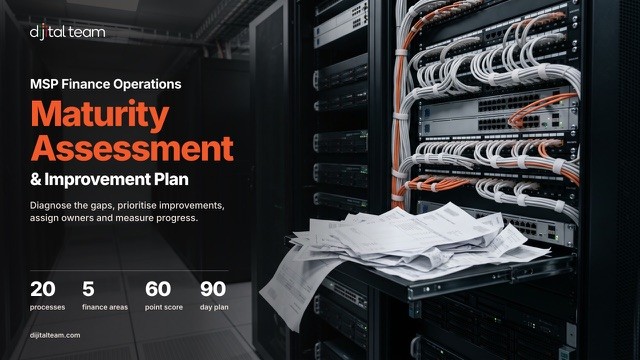
How mature are the finance processes that should stop the leaks?
Score 20 finance processes across billing, procurement, cash flow, reporting, controls and automation, then turn the gaps into a prioritised 90-day improvement plan.
- 20processes
- 5finance areas
- 60point score
- 90day plan
Stop chasing revenue and start protecting profit
Revenue growth is important, but it doesn't automatically translate into a more profitable MSP.
If your business is consistently delivering more services than it charges for, absorbing supplier cost increases or failing to update customer agreements, additional sales may simply mask the underlying problems.
The most profitable MSPs don't just focus on winning customers.
They focus on ensuring every customer relationship is commercially sustainable, every service is delivered efficiently and every billable activity is accurately captured.
Revenue leakage is rarely caused by one major mistake.
It's the accumulation of small gaps in systems, processes and accountability.
And those small gaps can make a significant difference to your bottom line.
Before investing in your next growth initiative, ask yourself a simple question: How much profit could we unlock by fixing the revenue we're already losing?
The answer might surprise you.
Frequently asked questions
Revenue leakage occurs when a Managed Service Provider fails to capture or invoice revenue it is entitled to earn. Common causes include unbilled licences, missing device charges, out-of-scope services, billing errors and outdated customer agreements.
MSPs can identify revenue leakage by reconciling customer agreements against actual users, devices, software licences, service desk activities, projects and invoices. Regular reporting and automated exception detection help identify recurring discrepancies.
MSP billing reconciliation is the process of comparing contracted services, actual consumption, supplier costs and invoices to ensure customers are billed accurately. It helps identify missed charges, incorrect quantities and other billing discrepancies.
MSPs should monitor customer profitability monthly, with more detailed commercial reviews conducted quarterly. Annual contract reviews should assess pricing, service inclusions and changes in customer requirements.
Automation can significantly reduce revenue leakage by identifying discrepancies between operational systems and billing records. Integrating PSA, RMM, licensing and accounting platforms helps MSPs detect changes, flag exceptions and update approved charges more consistently.
Revenue leakage is revenue an MSP should have earned but failed to capture. Margin erosion occurs when the cost of delivering services increases relative to revenue. Both affect profitability, but they require different corrective actions.
Build a more profitable MSP with Dijital Team
At Dijital Team, we believe sustainable MSP growth requires more than simply adding customers or increasing headcount.
It requires stronger margins, more mature service delivery and predictable operational performance.
Through our Better Business Pathway, we work alongside MSPs to help them identify opportunities to improve profitability, strengthen operational maturity and create more scalable businesses.
Combined with access to dedicated offshore technical and operational talent, we help MSPs build the capacity and capabilities needed to achieve more without continuously increasing their cost base.
Whether you're looking to improve service desk efficiency, strengthen your centralised services capability, accelerate automation or create more capacity for higher-value work, we're here to help.
Stop letting operational inefficiencies eat into your profit.
Book a conversation with Dijital Team and discover how we can help you build a more profitable, mature and scalable MSP.
- Better Business Pathway
- Dedicated offshore talent
- ISO 27001 certified
- Trusted by 120+ MSPs and ITSPs